




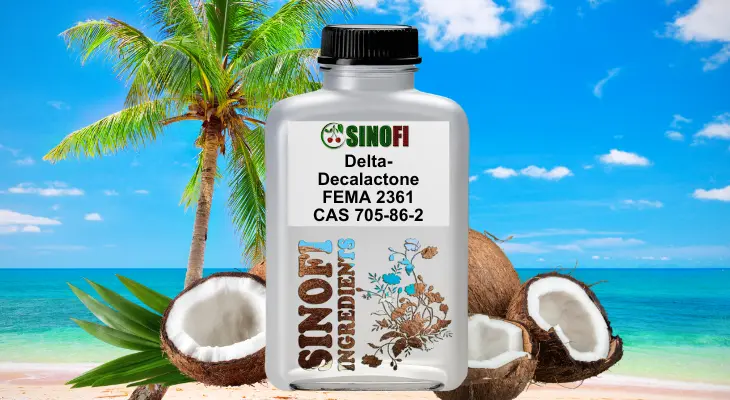
This section provides an overview of delta-decalactone (δ-decalactone), covering its manufacturing processes and regulatory status, applications in food, beverage, flavour, fragrance, personal care, and household product industries. Also, please check out the introduction to delta-decalactone manufacturers, supply chain issues, delta-decalactone suppliers, and delta-decalactone prices. Sinofi can help you buy delta-decalactone at bulk wholesale prices based on FEMA 2361 and CAS 705-86-2.
Table of Contents

What is Delta-Decalactone?
Delta-decalactone, also known as δ-decalactone, represents one of the most valuable lactone compounds in the flavour and fragrance industry. It occurs naturally in various fruits and dairy products, and its synthetic counterpart has become an indispensable tool for flavour formulation engineers seeking to create authentic fruity and creamy flavour profiles. Delta-decalactone features a six-membered lactone ring, which distinguishes it from its gamma-lactone counterparts that contain five-membered rings. This structural difference significantly influences both its aromatic profile and its stability characteristics in various applications. Its moderate solubility in water and excellent solubility in oils and alcohols make it well-suited for both aqueous and oil-based flavour systems. According to the U.S. Food and Drug Administration (FDA), delta-decalactone is approved to be used in the flavour, fragrance, and food industries.
Regulatory Status and Safety Considerations
Delta-decalactone has been evaluated by relevant regulatory authorities like JECFA, EFSA, RIFM, ECHACHEM, NIST, and WHO. Delta-decalactone has achieved regulatory approval in major markets worldwide for use in food and beverage applications. The compound is recognized as Generally Recognized as Safe by the Flavour and Extract Manufacturers Association (FEMA). It also appears on positive lists maintained by the regulatory authority in Europe.
From a safety perspective, delta-decalactone has been extensively evaluated through standard toxicological testing protocols, and no significant safety concerns have been identified at typical usage levels in flavoured products. It exhibits good stability under normal storage conditions, though it requires protection from oxidation and extreme pH conditions to maintain optimal organoleptic properties. The fragrance standard of delta-decalactone has been set by organizations such as IFRA.
Natural Occurrence and Sources
Delta-decalactone occurs naturally in various fruits, dairy products, and fermented foods. Peaches, apricots, strawberries, and coconuts contain delta-decalactone as part of their natural flavour complex. It also forms during the aging of certain cheeses and can be found in trace amounts in butter and cream. This natural occurrence has made delta-decalactone particularly valuable for creating authentic-tasting fruit flavours and dairy applications.
Sensory Profile and Flavour Characteristics
The sensory profile of delta-decalactone is dominated by a rich, creamy peach character with subtle coconut undertones. At low concentrations, typically between 0.5 and 5 parts per million, the compound delivers a fresh, fruity impression reminiscent of ripe peaches and apricots. As concentration increases, the profile shifts toward a more pronounced creamy, fatty character with distinctive coconut and buttery notes that can enhance dairy-type applications.
The odor threshold of delta-decalactone is remarkably low, often cited in the range of 0.01 to 0.1 parts per million in water, which allows flavour formulators to achieve significant impact with minimal usage levels. This potency requires careful handling and precise measurement during formulation to avoid overwhelming other flavour components. The compound’s flavour persistence is moderate, providing good mouthfeel and lingering fruit notes without excessive tenacity that might interfere with product balance.
CAS No.: 705-86-2
According to the American Chemical Society, the CAS number of delta-decalactone is 705-86-2.
CAS Name: δ-Decalactone
Molecular Formula: C10H18O2
Molecular Mass: 170.25
Appearance: Colorless to light yellow, clear liquid.
JECFA Number: 232
Food Chemicals Codex Listed: Yes
Boiling Point: 281.00 °C. @ 760.00 mm Hg
Solubility: Very soluble in alcohol and propylene glycol; insoluble in water.
Other Names:
♦ Delta-Decalactone
♦ 5-Decanolide
♦δ-Amylvalerolactone
♦ 5-Pentyl-5-pentanolide
♦δ-Pentyl-δ-valerolactone
♦ Dihydrojasmin lactone
♦δ-Decanolactone
Delta-Decalactone Odor
Odor Strength: Mediums
Substantivity: 336 hours at 100.00 %
Odor Description: At 100.00 %, coconut-fruity odour, butter-like on dilution.
FEMA Number 2361
According to the Flavour and Extract Manufacturers Association (FEMA), the FEMA number of delta-decalactone is 2361.
Bulk Delta-Decalactone Manufacturers
The bulk delta-decalactone manufacturing exhibits characteristics of a mature specialty chemical market with established players and broader food and beverage industry expansion. Top delta-decalactone manufacturers like Soda Aromatic and Givaudan typically emphasize quality consistency, regulatory compliance, and technical support services that command premium pricing in certain market segments. Chinese delta-decalactone manufacturers have emerged as dominant players in the global supply chain over the past two decades, leveraging cost advantages in raw materials and labor while developing substantial technical capabilities in lactone synthesis.
Sinofi is a bulk delta-decalactone manufacturer in China, and we have a manufacturing facility with 2,500 square meters for the production of delta-decalactone. We supply high-quality delta-decalactone at bulk prices and serve food, beverage, flavour, fragrance, personal care, and household product industries worldwide.
Manufacturing Process of Delta-Decalactone
The industrial manufacture of delta-decalactone represents a sophisticated application of synthetic organic chemistry requiring integration of chemical knowledge, process engineering expertise, and quality assurance discipline.
Primary Synthetic Routes
The commercial manufacture of δ-decalactone proceeds through several established synthetic pathways, with the choice of route dependent upon raw material availability, desired production scale, economic considerations, and technical capabilities of the manufacturing facility. The most widely employed industrial route involves the Baeyer-Villiger oxidation of 2-decalone followed by rearrangement, though alternative approaches through hydroxydecanoic acid cyclization and catalytic oxidation methods have gained increasing technical and commercial relevance.
The Baeyer-Villiger oxidation pathway begins with 2-decalone as the starting ketone substrate. Treatment with peracetic acid or meta-chloroperbenzoic acid under controlled conditions yields the corresponding lactone through oxygen insertion adjacent to the carbonyl group. This transformation proceeds through a Criegee intermediate wherein the peracid adds to the carbonyl carbon, followed by migration of one of the adjacent alkyl groups with simultaneous expulsion of the carboxylate leaving group.
An alternative synthetic approach involves the cyclization of 5-hydroxydecanoic acid or related hydroxy acid precursors. This route offers certain advantages in terms of atom economy and potential for sustainable production through biotechnology-derived hydroxy acids. The cyclization reaction typically employs acidic catalysis, with the hydroxyl group attacking the carbonyl carbon of the carboxylic acid moiety to form the lactone ring with elimination of water. Process implementation requires careful control of reaction conditions to drive the equilibrium toward lactone formation while managing competing intermolecular esterification reactions that can produce dimeric or oligomeric byproducts.
Bulk Delta-Decalactone Suppliers
The global delta-decalactone supply encompasses chemical manufacturers operating at various scales, from multinational corporations with diversified portfolios to specialized producers focusing on lactone compounds and aroma chemicals. Top delta-decalactone suppliers like Soda Aromatic and Givaudan maintain strong positions in the natural and high-purity segments, leveraging established expertise in flavour and fragrance chemistry. Asian suppliers dominate production capacity, with China emerging as a significant source of competitively priced synthetic delta-decalactone.
Sinofi is a bulk delta-decalactone supplier in China, and we have a warehouse with 1,200 square meters for high-quality delta-decalactone. We sell different grades of delta-decalactone at wholesale prices, serving end-users in food, beverage, flavour, fragrance, personal care, and household product industries.
Supply Chain of Delta-Decalactone
The delta-decalactone supply chain represents a complex network of specialized participants spanning raw material extraction through final product delivery to end users in the flavours and fragrances industry.
Supply Chain Structure and Tier Configuration
The delta-decalactone supply chain operates through a multi-tiered structure, with each level contributing distinct value-added functions and specialized capabilities. At the foundational level, raw material suppliers provide the essential inputs for delta-decalactone synthesis or extraction. The choice between synthetic and natural production pathways significantly influences the upstream supply chain structure and cost dynamics. The manufacturing tier comprises chemical producers with specialized capabilities in lactone chemistry, organic synthesis, or natural extraction technologies. Distribution and wholesale operations form the next tier, serving as crucial intermediaries between manufacturers and end users. Specialty chemical distributors maintain inventory positions, provide logistical services, and offer technical support to customers. These distributors often handle regulatory documentation, arrange transportation and storage, and manage smaller-volume orders that manufacturers prefer not to service directly. Flavour and fragrance houses constitute a critical intermediate tier in many delta-decalactone supply chains. These companies purchase bulk delta-decalactone from manufacturers or distributors, then incorporate the compound into proprietary flavour formulations or fragrance compositions. This tier performs essential blending, formulation development, and application expertise functions that translate raw aroma chemicals into commercial products meeting specific performance requirements.
Wholesale and Buy Delta-Decalactone in Bulk
Wholesale and bulk procurement of delta-decalactone demands professional purchasing management combining technical knowledge, commercial acumen, and relationship skills. Success requires comprehensive specification development, rigorous supplier qualification, strategic volume planning, effective price negotiation, efficient logistics management, proactive supplier relationship development, systematic risk management, and diligent regulatory compliance.
Understanding Product Specifications and Quality Requirements
The foundation of effective delta-decalactone procurement begins with a comprehensive understanding of technical specifications and quality parameters required for your specific applications. Purchasing managers must work closely with technical teams, quality assurance departments, and regulatory affairs specialists to document precise requirements before engaging potential suppliers. This specification development process prevents costly misunderstandings and establishes clear acceptance criteria for incoming material.
Purity levels constitute the primary specification parameter, with food-grade delta-decalactone typically requiring a minimum purity of ninety-five percent or higher. The remaining percentage comprises related compounds, minor impurities, and residual processing materials that must remain within acceptable limits to avoid off-notes or safety concerns. Beyond basic purity, specifications must address residual solvents, heavy metals, microbiological parameters, and organoleptic properties. These secondary parameters significantly impact product suitability despite receiving less attention than headline purity figures.
The distinction between synthetic and naturally-derived delta-decalactone creates fundamentally different specification and procurement considerations. Natural delta-decalactone commands premium pricing but enables natural labeling that provides marketing advantages for finished products in certain market segments. Purchasing managers must evaluate whether the price premium justifies the labeling benefits for their specific product portfolio, considering that consumer preferences for natural ingredients vary significantly across categories and geographic markets.
Supplier Identification and Qualification Process
Identifying qualified suppliers capable of meeting volume requirements, quality specifications, and service expectations demands systematic market research and rigorous evaluation processes. Purchasing managers should develop comprehensive supplier databases documenting capabilities, certifications, production capacities, and commercial terms for potential delta-decalactone sources. This database becomes a strategic asset supporting sourcing decisions, supplier diversification initiatives, and contingency planning for supply disruptions.
As a bulk delta-decalactone manufacturer and supplier in China, we wholesale this ingredient to end users in food, beverage, flavour, fragrance, personal care, and household product industries. We also supply it to small customers. Normally, they want to buy delta-decalactone in small quantities. To serve them, we can sell delta-decalactone at bulk prices and provide a one-stop purchasing service.
Delta-Decalactone Prices (USD/Kg)
Food Grade Delta-Decalactone Prices (GC Content >=98.0%)
| Volume | Unit Price | Shipment |
| 50g | 6 USD | Express |
| 500g | 29 USD | Express |
| 1Kg | 47 USD/Kg | Express |
| 20Kg | 35% cheaper | Express |
| 100Kg-Above | negotiable | Express / Sea |
Delta-decalactone pricing reflects sophisticated market dynamics balancing manufacturing economics, quality differentiation, supply-demand fundamentals, and competitive pressures. Current pricing levels incorporate elevated costs from energy, raw materials, and logistics, while competitive markets prevent extreme price levels absent significant supply disruptions.
Price Structure and Key Determinants
The pricing architecture for delta-decalactone encompasses multiple tiers reflecting different market segments, quality grades, and commercial relationships. Wholesale prices for bulk quantities generally range significantly lower than small-volume retail pricing. The relationship between volume and unit price follows predictable patterns where delta-decalactone buyers committing to larger quantities or longer-term contracts achieve more favorable rates than those making smaller spot purchases.
Manufacturing cost structures fundamentally drive baseline pricing for delta-decalactone across the market. Raw material inputs represent the largest single cost component, with synthetic production routes whose costs fluctuate with energy markets and feedstock availability. The specific synthesis pathway employed by different manufacturers creates cost variations based on process efficiency, yield optimization, and raw material selection.
Quality specifications exert considerable influence on pricing, as higher purity grades require additional processing steps, more rigorous quality control, and potentially lower overall yields. Food-grade delta-decalactone meeting stringent purity requirements and comprehensive safety testing commands premium pricing relative to technical grades suitable for non-food applications. The incremental cost associated with achieving and documenting higher quality specifications typically justifies price differentials of 10-20% between standard and premium grades, though exact premiums vary based on competitive dynamics and customer requirements. Delta-decalactone buyers should carefully evaluate whether premium specifications deliver proportional value for their specific applications, as unnecessarily tight specifications increase costs without corresponding benefits.
Synthetic Versus Natural Price Dynamics
The most significant pricing distinction within the delta-decalactone market separates synthetic and naturally-derived material, with natural sources typically commanding premiums of two hundred to three hundred percent compared to synthetic equivalents. This substantial price differential reflects the fundamentally different economics of natural production, which relies on extraction or isolation from botanical sources, yielding much lower concentrations than chemical synthesis achieves. The agricultural and processing costs associated with natural production, combined with more limited production capacity and higher demand for natural labeling, support these premium price levels despite ongoing pressure from cost-conscious buyers. The decision between synthetic and natural delta-decalactone involves careful cost-benefit analysis extending beyond simple price comparison. Natural material enables clean label claims that provide marketing advantages in consumer segments preferring natural ingredients, particularly for premium-positioned products in developed markets.
Furthermore, the above delta-decalactone price quotations do not include the express shipping fee. The reason is that the shipment cost may exceed the value of the delta-decalactone sample. However, the bulk wholesale prices of delta-decalactone will be much lower than those of small orders. Please contact us for more details.
Delta-Decalactone Specification
| Appearance: | Colorless to light yellow, clear liquid. |
| Odor: | Coconut-fruity odour, butter-like on dilution. |
| Purity (GC) | >=98% |
| Refractive Index (20°C) | 1.456 – 1.459 |
| Specific Gravity (25°C) | 0.964 – 0.971 |
| Acid Value (mg KOH/g) | <=5.0 |
| Heavy Metal (as Pb, mg/Kg) | <=10 |
| As (mg/Kg) | <=3 |
Delta-Decalactone Uses
Delta-decalactone demonstrates remarkable versatility across diverse applications spanning food and beverage flavouring, personal care fragrancing, and household product development. The compound’s distinctive peachy, apricot, and coconut sensory profile enables formulators to create appealing products meeting consumer expectations across numerous categories.
Flavour Applications
In flavour development, delta-decalactone serves multiple functions. Its primary application lies in stone fruit flavours, where it provides authentic coconut, peach, apricot, and nectarine notes. Formulators typically employ δ-decalactone at concentrations ranging from 0.5 to 50 parts per million in finished products, depending on the desired intensity and the specific matrix being flavoured. Beyond stone fruits, δ-decalactone plays a crucial role in tropical fruit flavours, particularly coconut and mango compositions. The compound adds richness and depth to these profiles while contributing a characteristic creamy mouthfeel sensation. In dairy flavour applications, δ-decalactone enhances butter, cream, and cheese notes, providing authenticity and fullness to formulations for ice cream, yogurt, and other cultured products. The compound also finds utility in beverage applications, where it contributes to fruit juice flavours, smoothie products, and alcoholic beverage formulations. In baked goods and confectionery, delta-decalactone adds fruity top notes and helps round out complex flavour profiles.
Fragrance Applications
In fragrance formulation, delta-decalactone contributes to both fine fragrance and functional fragrance products. The compound appears in fruity floral compositions, where it adds naturalness and diffusion to coconut, peach, and apricot accords. Its creamy character makes it valuable in oriental and gourmand fragrances, where it can support vanilla, tonka bean, and coumarin notes. Functional fragrance applications leverage δ-decalactone in personal care products, household cleaners, and fabric care formulations. Its pleasant, broadly acceptable character and good stability in various product matrices make it suitable for these applications.
Personal Care and Cosmetic Applications
Body care products, including shower gels, body washes, hand soaps, body lotions, and body sprays, commonly feature δ-decalactone in formulations targeting fruity or tropical positioning. Peach-scented body wash products often incorporate the compound as a primary fragrance component, delivering consumer-recognizable scent profiles. Tropical-themed collections combine δ-decalactone with other fruity and coconut notes, creating vacation-inspired sensory experiences. The compound’s substantivity on skin and compatibility with typical surfactant and emulsion systems make it technically suitable for these applications, performing reliably across diverse product formats.
Household and Industrial Applications
Household cleaning and care products represent an additional application sector for δ-decalactone, where the compound contributes to fragrance systems that influence consumer product perceptions and purchase decisions. Laundry detergents, fabric softeners, and dryer sheets may incorporate fruity notes, including δ-decalactone in fragrance blends, creating appealing scent profiles on clean laundry. The compound must demonstrate stability in the challenging chemical environments present in these products, maintaining fragrance integrity despite high alkalinity, oxidizing agents, or other reactive components. Formulators typically employ δ-decalactone as part of comprehensive fragrance systems rather than single-note applications, combining multiple aroma chemicals to create complex, consumer-appealing scent profiles.
Technical Considerations for Formulation
Formulation scientists must consider several technical factors when incorporating delta-decalactone into flavour or fragrance systems, ensuring optimal performance in finished products. Usage levels typically range from single-digit parts per million in subtle applications to several hundred parts per million where prominent peachy or coconut character is desired. The specific concentration required depends on the intended flavour or fragrance impact, the complexity of the overall formula, and the base matrix characteristics that influence perception. Experienced flavourists and perfumers develop an intuitive understanding of appropriate dosage levels through training and experience, though systematic evaluation and consumer testing ultimately validate formulation decisions.
Solubility characteristics influence how δ-decalactone incorporates into different base systems and how effectively the compound distributes throughout finished products. The compound demonstrates good solubility in most flavour and fragrance solvents, including ethanol, propylene glycol, and various oils, facilitating incorporation into both water-based and oil-based formulations. Emulsion systems require careful attention to partition coefficients, ensuring appropriate distribution between aqueous and lipid phases for optimal sensory delivery. Formulators may employ solubilizers or co-solvents in challenging applications where direct incorporation proves difficult.
Interaction effects with other formula components deserve consideration as δ-decalactone can influence and be influenced by surrounding ingredients. Synergistic relationships with complementary aroma chemicals amplify overall impact beyond simple additive effects, enabling more efficient flavour or fragrance delivery. Antagonistic interactions or masking effects might reduce perceived intensity, requiring usage level adjustments. Complex formulations benefit from systematic evaluation of component interactions, ensuring the final composition delivers intended sensory profiles rather than assuming individual component contributions simply combine without mutual influence.
Delta-Decalactone Benefits
Delta-decalactone delivers a comprehensive array of benefits spanning sensory performance, technical functionality, economic efficiency, marketing advantages, regulatory compliance, sustainability alignment, innovation enablement, and quality reliability. This multifaceted value proposition explains the compound’s widespread adoption across food, beverage, personal care, and household applications where manufacturers seek to optimize formulation performance while managing costs and addressing consumer preferences.
Sensory Performance and Consumer Appeal
The primary benefit of δ-decalactone stems from its exceptional ability to deliver recognizable, consumer-preferred fruit character across diverse product categories. The compound provides authentic peachy and apricot notes that consumers immediately recognize and associate with natural fruit, creating positive sensory experiences that influence purchase decisions and repeat consumption. This authenticity proves particularly valuable in applications where artificial or chemical-sounding fruit notes might diminish consumer acceptance or brand perception. The compound’s sensory profile aligns closely with natural fruit aromatics, helping formulators achieve the naturalness that modern consumers increasingly demand across food and personal care categories.
The versatility of δ-decalactone’s sensory profile represents another significant benefit, as the compound expresses different characteristics depending on concentration and surrounding ingredients. At lower usage levels, the material contributes subtle peachy freshness and fruity complexity without dominating overall flavour or fragrance profiles. Higher concentrations deliver pronounced tropical and coconut notes suitable for products specifically positioned around these flavour themes. This concentration-dependent character allows formulators to emphasize different aspects of the sensory profile based on product requirements, effectively providing multiple functional profiles from a single ingredient. Such versatility reduces formulation complexity and ingredient inventory requirements while expanding creative possibilities for product development teams.
Technical and Formulation Advantages
Delta-decalactone offers significant technical benefits that simplify formulation work and improve product performance across manufacturing and shelf life periods. The compound’s potency allows effective flavouring or fragrancing at relatively low usage levels, typically measured in parts per million rather than percentage points. This high impact-to-dosage ratio reduces raw material costs per unit produced while minimizing the formulation space required for flavour or fragrance systems. Efficient sensory delivery becomes particularly valuable in applications with limited available formulation room due to functional ingredient requirements, cost constraints, or regulatory limitations on certain component classes. A small quantity of δ-decalactone often achieves sensory objectives that might require substantially larger amounts of less potent materials.
The compound demonstrates good stability characteristics under typical storage and use conditions, maintaining sensory integrity throughout reasonable product shelf life periods. This stability reduces the need for substantial overages to compensate for degradation losses, improving cost efficiency while ensuring consistent consumer experiences across product life cycles.
Delta-Decalactone in E-Liquid and Vaping Products
The electronic cigarette and vaping industry has emerged as a significant application sector for flavouring ingredients, including delta-decalactone, which serves as a component in e-liquid formulations designed to deliver fruity and creamy flavour profiles. This lactone compound appears in various vaping products where manufacturers seek to create appealing sensory experiences for adult consumers through coconut, peach, apricot, and tropical fruit flavour notes.
The e-liquid flavour market demonstrates considerable diversity, with manufacturers offering extensive product ranges spanning fruit, dessert, beverage, menthol, and tobacco-inspired profiles. Within this landscape, delta-decalactone functions primarily as a supporting ingredient in complex flavour formulations rather than as a single-note flavour base. E-liquid flavour chemists combine the compound with complementary esters, aldehydes, and other aroma chemicals to create multidimensional flavour profiles that aim to provide satisfying sensory experiences during vaping. The technical challenges of flavour delivery through vaporization require careful formulation balancing to ensure that intended flavour profiles survive the heating process and deliver consistent sensory impact across different device types and user behaviours.
Usage patterns for delta-decalactone in e-liquids reflect both the compound’s potency and cost considerations that influence formulation economics. E-liquid manufacturers typically incorporate flavouring ingredients at total concentrations ranging from five to twenty percent of the final product, with individual components like δ-decalactone representing smaller fractions within these flavour systems. The specific usage levels depend on desired flavour intensity, the complexity of the overall formulation, and the concentration of other flavour components. Economic pressures in competitive vaping markets drive efficiency in flavour formulation, with manufacturers seeking to achieve target sensory profiles at minimum ingredient costs while maintaining quality standards.
Technical Formulation Considerations
E-liquid formulations present unique technical challenges that distinguish them from conventional food flavouring applications and require specialized expertise in vapor chemistry and delivery mechanisms. The base matrix for e-liquids typically consists of propylene glycol and vegetable glycerin in various ratios, with these carrier materials influencing both aerosol generation characteristics and flavour perception. Delta-decalactone must demonstrate compatibility with these base materials and maintain stability during storage in contact with these solvents. The compound’s solubility characteristics generally support incorporation into propylene glycol and vegetable glycerin systems, though formulators must verify appropriate dispersion and stability in specific product contexts.
Thermal stability assumes critical importance in e-liquid applications, given the heating process that generates vapor for inhalation. Delta-decalactone undergoes exposure to temperatures that may reach 200 to 300 degrees Celsius or higher, depending on device characteristics and user behavior. The vapor pressure and volatility characteristics of δ-decalactone influence how effectively the compound transfers from liquid to aerosol phase during vaping and how completely it delivers to users. Compounds with inappropriate volatility may preferentially remain in residual liquid rather than vaporizing efficiently, reducing flavour delivery and causing inconsistent sensory experiences. Conversely, highly volatile materials may flash off too readily, creating harsh initial experiences or depleting rapidly from cartridges. Delta-decalactone’s moderate volatility generally supports reasonable performance in vaping applications, though the presence of high-boiling vegetable glycerin and temperature variations across devices creates complexity in predicting exact vapor phase behavior.
Flavour perception through inhalation differs from oral consumption, with vapor temperature, particle size distribution, airflow patterns, and mucosal contact sites all influencing sensory experiences. Delta-decalactone’s characteristic peach and coconut notes translate to vapor delivery with some modification compared to oral tasting, requiring formulators to adjust usage levels and supporting ingredients to achieve desired flavour profiles in vaping contexts. The throat feel, cooling sensations, and vapor density additionally impact overall user experience beyond simple flavour delivery, creating multidimensional formulation objectives that extend beyond replicating beverage or food flavours.
Regulatory Landscape and Compliance Requirements
The regulatory framework governing delta-decalactone use in e-liquids varies substantially across jurisdictions, with divergent approaches reflecting different policy priorities and evolving understanding of product risks. The United States Food and Drug Administration regulates e-cigarettes and e-liquids as tobacco products under the Family Smoking Prevention and Tobacco Control Act, requiring premarket authorization for products marketed after specified dates. This regulatory pathway requires manufacturers to demonstrate that products are appropriate for the protection of public health, considering both risks and benefits, including effects on youth initiation and adult smoking cessation. Applications must address product formulation, manufacturing processes, labeling, and health impact evidence, including toxicological data for ingredients.
European Union regulations approach e-liquids through the Tobacco Products Directive, which establishes ingredient notification requirements, restricts certain substances, and imposes manufacturing and labeling standards. Member states implement these requirements with some variation in specific details, creating a patchwork of requirements across European markets. The directive requires ingredient notification, including all components and emissions data, restricts nicotine concentrations and container sizes, and prohibits ingredients that pose risks to human health in heated or unheated form. Delta-decalactone and other flavouring ingredients must comply with these frameworks, with manufacturers responsible for demonstrating that ingredients do not fall within prohibited categories and that overall product formulations meet applicable standards.
A Formula for Tobacco Flavouring
Include the following ingredients (by weight):
Acetic acid 0.3 parts, ethyl butyrate 0.3 parts, ethyl hexanoate 0.1 parts, ethyl heptanoate 0.2 parts, ethyl octanoate 0.2 parts, ethyl decanoate 0.1 parts, gamma-heptalactone 0.5 parts, gamma-octalactone 0.1 parts, delta-octalactone 0.08 parts, gamma-nonanolactone 1 part, delta-decalactone 0.5 parts, gamma-undecalactone 0.5 parts, heliotropin 0.3 parts, furfural 0.05 parts, octanal 0.08 parts, decanal 0.03 parts, vanillin 0.9 parts, ethyl vanillin 0.14 parts, maltol 0.05 parts, ethyl maltol 0.4 parts, Lactem 20 parts, frankincense essential oil 1 part, frankincense extract 8 parts, and solvent 65.17 parts (propylene glycol 40 parts, ethanol 25.17 parts).
The preparation method of the above-mentioned tobacco flavouring is as follows: Dissolve the main aroma component, top aroma component, and modifying component in a solvent by stirring.
In conclusion, delta-decalactone demonstrates remarkable versatility across food, beverage, flavour, fragrance, personal care, and household applications, delivering characteristic peachy, creamy sensory impressions valued by formulators and consumers alike. As a bulk delta-decalactone manufacturer and supplier in China, we sell different grades of delta-decalactone at wholesale prices to clients around the world.