





This section provides an overview of raspberry ketone, covering its manufacturing processes and regulatory status, applications in flavour, fragrance, nutraceutical, and cosmetic industries. Also, please check out the introduction to raspberry ketone manufacturers, supply chain issues, raspberry ketone suppliers, and raspberry ketone prices. Sinofi can help you buy raspberry ketone at bulk wholesale prices based on FEMA 2588 and CAS 5471-51-2.
Table of Contents
What is Raspberry Ketone?
Raspberry ketone, commercially named rheosmin or frambinone, has established itself as a versatile ingredient serving multiple industries. It transcends its origins as a simple fruit aroma chemical to fulfil diverse functional roles across flavour, fragrance, nutraceutical, and cosmetic applications. Raspberry ketone consists of a para-hydroxyphenyl group linked to a butanone chain, a configuration that contributes to both its characteristic aroma and its chemical stability under normal formulation conditions. This phenolic hydroxyl group also imparts mild antioxidant properties, though these are secondary to its primary function as an aroma compound. According to the U.S. Food and Drug Administration (FDA), raspberry ketone is approved to be used in the flavour, fragrance, and food industries.
Regulatory Status and Safety Considerations
Raspberry ketone has been evaluated by major regulatory bodies like JECFA, EFSA, RIFM, ECHACHEM, NIST, and WHO. It holds a generally favourable regulatory status in major markets. In the United States, it is classified as Generally Recognized as Safe and is approved for use as a flavouring substance. The European Union includes it in the Union List of authorised flavourings, and it is similarly permitted in most other jurisdictions with established food additive frameworks. Flavour formulators must nevertheless remain attentive to the distinction between synthetic and natural designations, as labelling requirements differ across markets. Products marketed with natural claims may require raspberry ketone derived from approved natural sources or produced through qualifying biotechnological processes. The fragrance standard of raspberry ketone has been set by organizations such as IFRA.
Odor Threshold and Sensory Profile
The sensory characteristics of raspberry ketone make it indispensable for berry flavour development. At high concentrations, the compound presents an intensely sweet, fruity, and berry-forward aroma with a distinct raspberry character. As concentrations decrease toward typical usage levels, the profile reveals additional nuances, including subtle floral, woody, and slightly jammy undertones.
In taste applications, raspberry ketone contributes a sweet, berry-like flavour impression that complements its aromatic profile. It performs well in applications where both orthonasal and retronasal perception are important to the overall sensory experience.
Natural Occurrence
In nature, raspberry ketone occurs in red raspberries at concentrations typically ranging from 1 to 4 milligrams per kilogram of fresh fruit. It is also found in smaller quantities in other fruits, including cranberries, blackberries, and certain varieties of grapes and peaches. The compound is biosynthesized in plants through the phenylpropanoid pathway.
CAS No.: 5471-51-2
According to the American Chemical Society, the CAS number of raspberry ketone is 5471-51-2.
CAS Name: 4-(4′-Hydroxyphenyl)-2-butanone
Molecular Formula: C10H12O2
Molecular Mass: 164.20
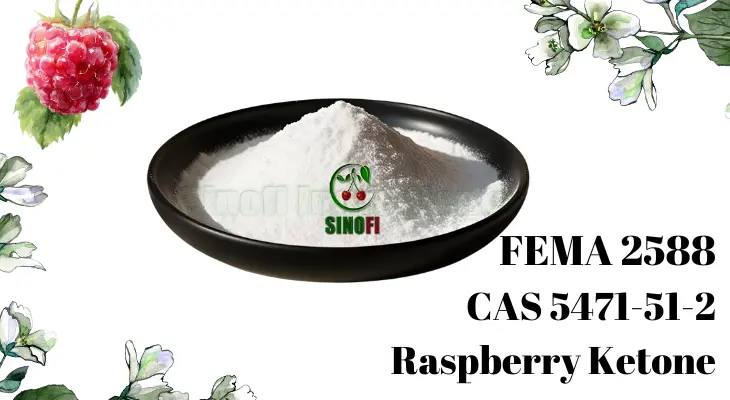
Appearance: White acicular or granular crystal.
JECFA Number: 728
Food Chemicals Codex Listed: Yes
Boiling Point: 200.00 °C. @ 760.00 mm Hg
Solubility: Insoluble in water; soluble in oils.
Other Names:
♦ 4-(4-Hydroxyphenyl)-2-butanone
♦ (p-Hydroxybenzyl)acetone
♦ 4-(p-Hydroxyphenyl)-2-butanone
♦ 1-(p-Hydroxyphenyl)-3-butanone
♦ Rheosmin
♦ Frambinone
♦ 1-(4-Hydroxyphenyl)-3-butanone
Raspberry Ketone Odor
Odor Strength: Medium.
Substantivity: 400 hours at 20.00 % in dipropylene glycol.
Odor Description: At 10.00 % in dipropylene glycol, sweet berry jam, raspberry, ripe floral.
FEMA Number 2588
According to the Flavour and Extract Manufacturers Association (FEMA), the FEMA number of raspberry ketone is 2588.
Bulk Raspberry Ketone Manufacturers
Manufacturing capacity for bulk raspberry ketone is concentrated in several key regions, each with distinct characteristics relevant to procurement decisions. Top raspberry ketone manufacturers like IFF, Ernesto Ventos, and Lluch Essence maintain sophisticated production capabilities, though their participation in the commodity bulk market varies according to strategic priorities. China represents the dominant production centre for synthetic raspberry ketone, housing the majority of global manufacturing capacity. Chinese raspberry ketone manufacturers have invested substantially in dedicated facilities over the past fifteen years, achieving economies of scale that enable competitive pricing. The primary manufacturing clusters are located in provinces with established fine chemical and pharmaceutical intermediate industries. These regions benefit from developed chemical supply chains, experienced technical workforces, and proximity to major ports for export logistics.
Sinofi is a bulk raspberry ketone manufacturer in China, and we have a manufacturing facility with 2,500 square meters for the production of raspberry ketone. We supply high-quality raspberry ketone at bulk prices and serve the flavour, fragrance, nutraceutical, and cosmetic industries worldwide.
Manufacturing Process of Raspberry Ketone
The industrial manufacture of raspberry ketone rests primarily on the well-established aldol condensation-hydrogenation sequence, which offers favourable economics and reliable quality when properly executed.
Primary Synthetic Route: Aldol Condensation and Hydrogenation
The dominant industrial manufacturing process for raspberry ketone proceeds through a two-step sequence comprising base-catalysed aldol condensation followed by selective hydrogenation of the resulting unsaturated intermediate.
Aldol Condensation Step
The first transformation involves the crossed aldol condensation between 4-hydroxybenzaldehyde and acetone. This reaction exploits the difference in reactivity between the aldehyde carbonyl of hydroxybenzaldehyde, which serves as the electrophilic acceptor, and acetone, which provides the nucleophilic enolate component.
Catalytic Hydrogenation Step
The second transformation converts the alpha,beta-unsaturated ketone intermediate to raspberry ketone through selective reduction of the carbon-carbon double bond. This transformation must achieve hydrogenation of the alkene functionality while preserving both the ketone carbonyl and the phenolic hydroxyl groups.
Friedel-Crafts Acylation Routes
Friedel-Crafts acylation of phenol or protected phenol derivatives with appropriate acylating agents represents a conceptually distinct approach. Reaction with 4-chlorobutyryl chloride or with methyl vinyl ketone under Lewis acid catalysis can potentially yield raspberry ketone or direct precursors. However, the electron-rich aromatic ring of phenol creates challenges with regioselectivity and over-acylation, and the Lewis acid catalysts commonly employed in Friedel-Crafts chemistry are incompatible with the phenolic hydroxyl without protection strategies.
Grignard and Organometallic Routes
Organometallic approaches involving Grignard reagents derived from protected 4-bromophenol with acetyl-containing electrophiles have been explored. While chemically viable, these routes involve additional protection and deprotection steps, air-sensitive intermediates, and generate significant metal salt waste streams, rendering them less attractive for large-scale manufacturing.
Bulk Raspberry Ketone Suppliers
The bulk raspberry ketone supply comprises several distinct supplier categories, each serving different customer needs and occupying different positions in the value chain. Top raspberry ketone suppliers like IFF, Ernesto Ventos, and Lluch Essence operate chemical synthesis or biotechnology production facilities and sell directly to end users or through distribution channels. These raspberry ketone suppliers offer the most direct access to production capacity and typically provide the greatest flexibility in specification customisation and volume commitments. Relationships with primary manufacturers often yield the most favourable pricing for large-volume requirements but may involve minimum order quantities that exceed the needs of smaller buyers. Trading companies and specialty chemical suppliers maintain inventory positions in raspberry ketone and other aroma chemicals, providing rapid availability and smaller lot sizes than direct manufacturer purchases typically permit. These distributors add value through local warehousing, technical support, regulatory documentation, and the convenience of consolidated purchasing across multiple product lines. China dominates the supply of synthetic raspberry ketone, with dozens of manufacturers and trading companies offering raspberry ketone for export.
Sinofi is a bulk raspberry ketone supplier in China, and we have a warehouse with 1,200 square meters for high-quality raspberry ketone. We sell different grades of raspberry ketone at wholesale prices, serving end-users in the flavour, fragrance, nutraceutical, and cosmetic industries.
Supply Chain of Raspberry Ketone
The raspberry ketone supply chain represents a moderately complex network connecting chemical raw material producers, synthesis facilities, distribution intermediaries, and diverse end-use industries.
Supply Chain Structure
The raspberry ketone supply chain can be conceptualised as a series of interconnected tiers, each adding value through transformation, logistics, or commercial services. The following structural overview describes the principal tiers and their relationships.
Tier One: Raw Material Supply
The foundation of the raspberry ketone supply chain rests on the supply of fundamental raw materials, primarily derived from petrochemical sources. The two essential starting materials for conventional synthesis are 4-hydroxybenzaldehyde and acetone, both of which trace their origins to petroleum refining and basic chemical manufacturing.
Tier Two: Chemical Intermediate Production
The second tier of the supply chain encompasses the production of 4-hydroxybenzaldehyde and other intermediates that do not reach raspberry ketone manufacturers directly from primary petrochemical producers. This tier includes specialty chemical manufacturers who transform basic chemicals into the specific intermediates required for raspberry ketone synthesis.
Tier Three: Raspberry Ketone Manufacturing
The manufacturing tier represents the core transformation stage where raw materials and intermediates are converted into raspberry ketone through chemical synthesis or biotechnological processes. This tier comprises the primary manufacturers who operate production facilities and control the fundamental supply of raspberry ketone to the market.
Tier Four: Trading and Distribution
The fourth tier encompasses the commercial intermediaries who facilitate the flow of raspberry ketone from manufacturers to end users. This tier includes trading companies, export agents, specialty chemical distributors, and logistics service providers.
Tier Five: End Users and Applications
The final tier of the supply chain comprises the manufacturers who incorporate raspberry ketone into finished products destined for consumer markets. This tier includes flavour companies, fragrance houses, nutraceutical manufacturers, and cosmetic producers.
Wholesale and Buy Raspberry Ketone in Bulk
Wholesale and bulk purchasing of raspberry ketone requires systematic attention to requirements definition, supplier identification and qualification, commercial negotiation, quality management, logistics execution, and risk mitigation. Whether sourcing for flavour compounding, fragrance formulation, nutraceutical manufacturing, or other industrial applications, raspberry ketone buyers should secure a reliable supply of specification-compliant material at a competitive cost.
Bulk Purchase Requirements for Raspberry Ketone
Before engaging the supplier market, raspberry ketone buyers must develop a clear understanding of their organization’s requirements. This foundational work shapes all subsequent procurement activities and prevents costly misalignments between purchased material and application needs.
Volume assessment represents the starting point for bulk purchasing planning. Annual consumption should be estimated based on production forecasts, accounting for anticipated growth or contraction in demand. Specification requirements must be defined with precision before supplier engagement. Standard commercial raspberry ketone typically carries purity specifications of 98% to 99% minimum, but applications may require tighter specifications or control of particular impurities.
Identifying Potential Suppliers
The wholesale raspberry ketone market includes diverse supplier types, each offering distinct advantages and limitations. Effective procurement strategies typically involve identifying and evaluating suppliers across multiple categories. Direct manufacturer sourcing provides access to primary production capacity and typically offers the most favourable pricing for substantial volumes. Trading companies and export agents offer an alternative pathway to manufacturer supply, providing services including supplier aggregation, quality inspection, export documentation, and consolidated logistics.
As a bulk raspberry ketone manufacturer and supplier in China, we wholesale this ingredient to end users in the flavour, fragrance, nutraceutical, and cosmetic industries. We also supply raspberry ketone to small customers. Normally, they want to buy raspberry ketone in small quantities. To serve them, we can sell raspberry ketone at bulk prices and provide a one-stop purchasing service.
Raspberry Ketone Prices (USD/Kg)
Food Grade Raspberry Ketone Prices (GC Content >=99%)
| Volume | Unit Price | Shipment |
| 50g | 7 USD | Express |
| 500g | 33 USD | Express |
| 1Kg | 48 USD/Kg | Express |
| 20Kg | 30% cheaper | Express |
| 100Kg-Above | negotiable | Express / Sea |
Raspberry ketone pricing spans an extraordinary range depending on source type, purity, and purchase volume. Synthetic raspberry ketone, representing approximately 95% of the commercial supply, shows wide pricing variation based on origin and certification. Chinese raspberry ketone suppliers offer bulk material at $25-55/kg for 99% purity product. North American and European distributors applying local quality controls price wholesale synthetic at $40-80/kg. Laboratory-grade material from Sigma-Aldrich reaches $150-500/Kg equivalent for small quantities. Naturally equivalent raspberry ketone extracted remains one of the most important natural flavour ingredients globally, commanding $200-550/kg. Natural material serves exclusively high-end fragrance, premium cosmetics, and clean-label supplement applications where the “natural” designation justifies high cost premiums
Furthermore, the above raspberry ketone price quotations do not include the express shipping fee. The reason is that the shipment cost may exceed the sample value of raspberry ketone. However, the bulk wholesale prices of raspberry ketone will be much lower than those of small orders. Please contact us for more details.
Raspberry Ketone Specification
| Appearance | White acicular or granular crystal. |
| Odor: | Sweet berry jam, raspberry, ripe floral. |
| Purity (GC) | >=99% |
| Melting Point (°C) | >=83 |
| Heavy Metal (as Pb, mg/Kg) | <=10 |
| As (mg/Kg) | <=1 |
Raspberry Ketone Uses
Raspberry ketone has a remarkably diverse range of applications across the flavour, fragrance, nutraceutical, and cosmetic industries, with additional uses in research and emerging areas.
Flavour Industry Applications
The flavour industry represents the historical foundation and continuing primary market for raspberry ketone. As the character-impact compound of raspberry, this molecule serves as an indispensable building block for flavourists creating berry profiles and related fruit flavour systems.
Raspberry Flavour Development
Raspberry ketone functions as the defining aromatic signature in raspberry flavour formulations. Natural raspberry fruit contains this compound at concentrations typically ranging from one to four milligrams per kilogram, where it contributes to the distinctive sweet, fruity, berry character that consumers associate with the fruit. In compounded flavours, raspberry ketone provides the authentic raspberry impression that distinguishes quality formulations from generic berry profiles.
Berry Blend Formulations
Beyond single-fruit raspberry applications, raspberry ketone contributes essential character to compound berry flavours, including mixed berry, forest fruit, berry medley, and similar profiles. In these complex formulations, raspberry ketone interacts synergistically with other berry aroma chemicals to create the impression of fruit complexity that consumers expect from premium berry products.
Fruit Flavour Enhancement
Raspberry ketone is used as a modifier and enhancer of fruit flavours beyond the berry category. Small additions can impart ripe, sweet character to stone fruit profiles such as peach, apricot, and nectarine, where the compound contributes jammy depth without introducing recognisable raspberry notes. Similar applications in tropical fruit formulations can enhance perceived ripeness and sweetness.
Food and Beverage Applications
The end-use applications for raspberry ketone in flavour systems span virtually the entire food and beverage industry. Beverages, including carbonated soft drinks, flavoured waters, juice drinks, alcoholic beverages, and dairy-based drinks, employ raspberry and berry flavours containing this compound. Confectionery applications, including hard candies, gummies, chocolates, and chewing gum, rely on raspberry ketone for authentic berry character. Dairy products, including yogurts, ice creams, and flavoured milk, incorporate raspberry flavouring. The compound’s stability under typical food processing conditions, including pasteurisation and baking temperatures, supports this broad application range.
Fragrance Industry Applications
The fragrance industry represents a significant secondary market for raspberry ketone, where the compound contributes a fruity character to fine fragrances and functional perfumes across multiple product categories.
Fine Fragrance Compositions
Perfumers incorporate raspberry ketone into fragrance compositions seeking a fruity, berry-forward character. The compound appears in both feminine and unisex fragrances, contributing sweet, natural fruit notes that complement floral, gourmand, and fresh accords. Modern fragrance trends favouring fruit-forward profiles have supported continued interest in raspberry ketone as a compositional element.
Personal Care Fragrances
Functional fragrances for personal care products, including shampoos, conditioners, body washes, lotions, and creams, frequently incorporate raspberry and berry profiles containing raspberry ketone. These applications value the compound’s pleasant, universally appealing character and its ability to convey freshness and femininity in product fragrancing.
The stability of raspberry ketone under the pH conditions and chemical environments encountered in personal care formulations supports reliable performance in these applications. The compound maintains its character in both leave-on and rinse-off products, though usage levels may be adjusted to account for different exposure durations and dilution factors.
Home Care and Household Products
Air fresheners, fabric care products, household cleaners, and similar consumer products employ raspberry ketone within fruity fragrance profiles. The compound’s ability to mask malodours while contributing pleasant fruit character makes it valuable in functional applications where fragrancing serves both hedonic and practical purposes.
Nutraceutical and Dietary Supplement Applications
Raspberry ketone gained prominence in the dietary supplement industry in the early 2010s, when it was marketed as a weight-management ingredient. This application sector, while more volatile than flavour and fragrance uses, continues to represent a meaningful component of demand.
Cosmetic Applications
Raspberry ketone has attracted interest for topical cosmetic applications based on proposed mechanisms related to skin physiology. While these applications remain less commercially developed than flavour, fragrance, and supplement uses, they represent an area of ongoing investigation and niche market activity.
Raspberry Ketone Benefits
Raspberry ketone delivers a spectrum of benefits ranging from the thoroughly established to the speculatively proposed. The compound’s sensory benefits in flavour and fragrance applications are well-documented and commercially proven, providing authentic raspberry character, formulation efficiency, and stability that support diverse product applications.
Sensory and Organoleptic Benefits
The most thoroughly established benefits of raspberry ketone relate to its sensory properties, which have underpinned its commercial value in the flavour and fragrance industries for decades. Raspberry ketone delivers the defining aromatic signature that consumers associate with raspberry fruit. This benefit is fundamental to the compound’s commercial importance, as no synthetic alternative provides an equivalent raspberry character.
Stability and Formulation Compatibility
Raspberry ketone demonstrates good stability under typical food processing and storage conditions, representing a practical benefit for manufacturers requiring reliable ingredient performance. The compound withstands pasteurisation temperatures encountered in beverage manufacture, baking temperatures in confectionery applications, and the pH ranges typical of most food systems. This stability ensures that the sensory benefits of raspberry ketone are preserved throughout product manufacture and shelf life, delivering consistent consumer experiences.
Raspberry Ketone in E-Liquid and Vaping Products
Berry flavours, including raspberry and mixed berry profiles, consistently rank among the most popular flavour categories in consumer research and sales data.
Functional Role in E-Liquid Formulation
Raspberry ketone serves as the primary character-impact compound in raspberry-flavoured e-liquids, fulfilling an analogous function to its role in traditional food flavouring. The compound provides the distinctive sweet, fruity, berry note that consumers associate with raspberry, enabling e-liquid formulators to create profiles ranging from single-note raspberry to complex berry blends and fruit combinations.
The potency of raspberry ketone proves advantageous in e-liquid applications, where flavour loading must be balanced against viscosity, vapour production, and device compatibility considerations. The compound’s low odour threshold, measured in parts per billion, means that effective raspberry character can be achieved at modest concentrations, leaving formulation space for complementary ingredients and base components.
In e-liquid formulation, raspberry ketone typically functions within a broader flavour system rather than as a standalone ingredient. Formulators combine it with supporting compounds that provide depth, complexity, and balance to the overall profile. Common complementary ingredients include other fruit esters and lactones that contribute sweetness and body, cooling agents that enhance perceived freshness, and sweeteners that round the overall impression. The art of e-liquid flavour development lies in balancing these components to create satisfying sensory experiences that perform well across diverse vaping devices and user preferences.
Regulatory Framework and Industry Standards
Regulatory restrictions on flavoured e-liquids have materially affected raspberry ketone demand in affected markets. The Family Smoking Prevention and Tobacco Control Act, for example, has reduced demand from manufacturers serving those markets. Conversely, markets maintaining permissive approaches to flavoured products continue to generate demand growth as vaping adoption expands. The EU Tobacco Products Directive creates planning challenges for both e-liquid manufacturers and ingredient suppliers. Manufacturers may hesitate to invest in product development for markets where regulatory changes could eliminate commercial viability.
A Liquid Watermelon Essence
Include the following ingredients (by weight):
Melon heptenal propylene glycol acetal 12%; Propylene glycol 67.5%; cis-3-Hexenol 3.0%; cis-6-Nonen-1-ol 2.0%; 1-Nonanol 7.0%; Vanillin 2.0%; Melonal 2.0%; Cyclamen aldehyde 1.0%; Raspberry ketone 0.3%; beta-Ionone 0.4%; Dihydrojasmone 0.5%; Ethyl hexanoate 0.5%; cis-3-Hexenyl acetate 0.3%; Diethyl sebacate 0.5%; Ethyl acetoacetate 0.2%; Methyl octine carbonate 0.2%; Benzyl cinnamate 0.3%; Ethyl maltol 0.5%. The sum of the weight percentages of all the above ingredients is 100%.
In conclusion, raspberry ketone occupies a distinctive position in the aroma chemicals market. Its primary and most stable demand base comes from flavour and fragrance manufacturers, who require a consistent supply of berry flavour formulations for food, beverage, and personal care applications. As a bulk raspberry ketone manufacturer and supplier in China, we sell different grades of raspberry ketone at wholesale prices to clients around the world.