




This section provides an overview of trimethylamine N-oxide (TMAO), covering its manufacturing processes and regulatory status, applications in fish feed, flavour, fragrance, research, and industrial chemical industries. Also, please check out the introduction to TMAO manufacturers, supply chain issues, TMAO suppliers, and TMAO prices. Sinofi can help you buy trimethylamine N-oxide at bulk wholesale prices based on FEMA 4245, CAS 1184-78-7 (anhydrous) and 62637-93-8 (dihydrate).
Table of Contents
What is Trimethylamine N-Oxide (TMAO)?
Trimethylamine N-oxide (TMAO) is a small, water-soluble organic amine oxide that occupies a central position in marine biochemistry, seafood quality assessment, and, more recently, nutritional and clinical research. For professionals working in food and feed research and development, TMAO is significant on two fronts: it serves as a natural quality marker whose enzymatic and microbial degradation drives the spoilage chemistry of fish and marine ingredients, and it functions as a physiologically active compound whose metabolic fate has implications for both animal nutrition and human health. Structurally, trimethylamine N-oxide is a tertiary amine oxide in which the nitrogen atom carries a formal positive charge and the bonded oxygen carries a formal negative charge, producing a stable internal zwitterion with a strongly polar N–O bond. Because of this charge separation, the molecule possesses a large dipole moment and interacts favorably with water. In commerce and laboratory practice, TMAO is most commonly encountered as the dihydrate, the more stable and readily handled crystalline form. According to the U.S. Food and Drug Administration (FDA), trimethylamine N-oxide is approved to be used in the flavour and fragrance industries.
Regulatory Status and Safety Considerations
Trimethylamine N-oxide has been evaluated by major regulatory bodies like JECFA, EURLEX, ECHACHEM, NIST, and WHO. It is recognized by the Flavour and Extract Manufacturers Association under FEMA number 4245. TMAO, especially in its stable dihydrate form, is generally regarded as a low-hazard substance for laboratory and ingredient handling, although standard chemical hygiene practices apply. As with any fine powder or reagent, contact with skin and eyes, and inhalation of dust, should be avoided, and the material should be stored in a cool, dry, well-sealed container to limit moisture uptake and potential reduction.
Natural Occurrence and Biological Function
TMAO is abundant in marine animals, including teleost fish, elasmobranchs (sharks and rays), crustaceans, and mollusks. In these organisms, it serves several interrelated physiological roles:
- Osmoregulation: TMAO contributes to intracellular osmolyte pools that allow marine animals to maintain osmotic balance with seawater.
- Protein stabilization: TMAO is a classic protecting osmolyte. It favors the folded, native state of proteins and counteracts the destabilizing influence of denaturants. In cartilaginous fish, which retain high concentrations of urea for osmotic purposes, TMAO offsets the protein-destabilizing effect of urea, with a counteraction ratio frequently cited at approximately two parts urea to one part TMAO.
- Piezolyte function: In deep-sea species, TMAO accumulates with depth and helps proteins resist the destabilizing effects of high hydrostatic pressure, functioning as a pressure-counteracting solute.
The high baseline concentration of TMAO in marine tissue is precisely why it becomes such an important driver of quality change once the animal is harvested. This natural protein-protecting function underpins its role as a feed attractant, and its water-binding properties support its use as a humectant. In aquatic feed formulations, TMAO, disodium 5′-inosinate (IMP), dimethyl-β-propiothetin (DMPT), and betaine serve as feed attractants that significantly increase daily feed intake in fish.
Degradation Chemistry and Seafood Spoilage
For food scientists, the most operationally relevant feature of TMAO is its breakdown during storage. After death, enzymatic and microbial activity convert TMAO into volatile, odor-active compounds. Two principal pathways operate:
- Bacterial reduction to trimethylamine (TMA). Spoilage microorganisms reduce TMAO to TMA, the compound chiefly responsible for the characteristic “fishy” odor of aging and spoiled fish. The accumulation of TMA correlates closely with loss of freshness and is one of the most widely used chemical indices of seafood quality.
- Demethylation to dimethylamine (DMA) and formaldehyde. Endogenous enzymes, notably TMAO demethylase (active particularly in gadoid species such as cod, hake, and pollock), cleave TMAO into DMA and formaldehyde. The liberated formaldehyde can cross-link muscle proteins, contributing to texture toughening, reduced water-holding capacity, and protein denaturation during frozen storage.
These reactions are central to the practical management of seafood and marine-derived ingredients and inform decisions on chilling, freezing temperatures, storage duration, and processing for species prone to formaldehyde-induced quality loss.
Aquaculture Feed Additives
A notable and growing segment, particularly among Chinese manufacturers, positions TMAO as a natural feed additive and feeding attractant. Research literature indicates that TMAO stimulates olfactory response and feeding behavior in several farmed fish species and has been studied for effects on lipid metabolism and flesh quality. A 2026 feeding study in largemouth bass characterized TMAO as a promising functional feed additive and reviewed prior findings of reduced fat deposition in species such as bluntnose black bream and Nile tilapia. This application links TMAO demand to the broader expansion of intensive aquaculture.
Relevance to Feed Science
In the feed sector, TMAO and its degradation products are particularly relevant to fish meal and other marine-derived feed ingredients:
- Ingredient quality and freshness. Fish meal manufactured from poorly preserved raw material contains elevated levels of TMA and other volatile bases. These markers are used to grade raw-material freshness and finished-meal quality, and they influence palatability and acceptance in aquafeeds.
- Formaldehyde and protein damage. The demethylation pathway that generates formaldehyde during the storage of marine raw materials can reduce protein digestibility and nutritional value. Controlling raw material freshness and processing conditions limits this loss.
- Palatability and feed intake. Volatile amines affect the sensory profile of feed. Excessive amine load from degraded marine ingredients can depress intake in sensitive species, whereas appropriately handled marine meals retain attractant properties valued in aquaculture diets.
- Metabolic considerations. Dietary precursors of TMA—such as choline, L-carnitine, and betaine, all common feed additives—are metabolized by gut microbiota to TMA, which can subsequently be oxidized to TMAO in the host.
This connection is increasingly considered when evaluating additive strategies and the metabolic profile of animals raised on marine-rich diets.
Endogenous Metabolism and Health Implications
Beyond its dietary presence, TMAO is also produced within the body. Gut microbiota convert dietary precursors—principally choline, phosphatidylcholine, L-carnitine, and betaine—into trimethylamine. This TMA is absorbed and transported to the liver, where the flavin-containing monooxygenase 3 (FMO3) enzyme oxidizes it to TMAO. Circulating TMAO is then largely excreted in urine. Over the past decade, elevated plasma TMAO has been investigated as a potential biomarker associated with cardiovascular and metabolic conditions. It is important to note that this remains an active and evolving area of research, that associations do not establish causation, and that findings should be interpreted with appropriate scientific caution.
CAS No.: 1184-78-7
According to the American Chemical Society, the CAS number of trimethylamine N-oxide is 1184-78-7.
CAS Name: Trimethylamine oxide
Molecular Formula: C3H9NO
Molecular Mass: 75.11
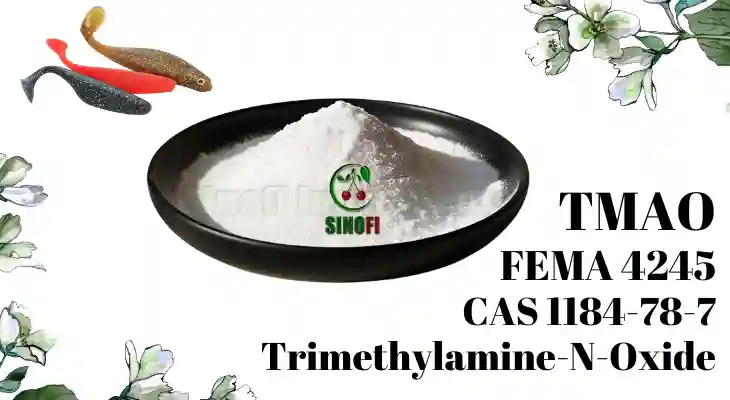
Appearance: Off-white crystal powder.
JECFA Number: 1614
Food Chemicals Codex Listed: No
Melting Point: 213.00 °C. @ 760.00 mm Hg
Solubility: Soluble in alcohol and water
Other Names:
♦ Methanamine, N,N-dimethyl-, N-oxide
♦ Trimethylamine, N-oxide
♦ TMAO
♦ Trimethylamine oxide
♦ Triox
♦ N,N-Dimethylmethanamine N-oxide
♦ N,N-Dimethylmethanamine oxide
FEMA Number 4245
According to the Flavour and Extract Manufacturers Association (FEMA), the FEMA number of trimethylamine N-oxide is 4245.
Bulk Trimethylamine N-Oxide (TMAO) Manufacturers
Trimethylamine N-oxide is a specialty fine chemical with a comparatively narrow but diversified set of end uses. It occupies a niche served by a mix of Western research-grade manufacturers and a substantial base of Chinese companies. Top trimethylamine N-oxide manufacturers like Sigma-Aldrich and TCI serve the laboratory, analytical, and fine-chemical synthesis segments with documented purity and strong regulatory paperwork. China hosts the largest concentration of bulk TMAO manufacturers, typically supplying the dihydrate in drum quantities and frequently emphasizing the feed-additive and industrial applications.
Sinofi is a bulk TMAO manufacturer in China, and we have a manufacturing facility with 2,500 square meters for the production of trimethylamine N-oxide. We supply high-quality TMAO at bulk prices and serve fish feed, flavour, fragrance, research, and industrial chemical industries worldwide.
Manufacturing Process of Trimethylamine N-Oxide (TMAO)
The industrial manufacture of trimethylamine N-oxide rests on a single, robust transformation: the selective oxidation of trimethylamine by hydrogen peroxide to give the amine oxide, isolated as a stable crystalline dihydrate. The chemistry is clean and atom-efficient, and the principal engineering challenges lie not in the reaction itself but in the surrounding operations—controlling the exotherm, destroying residual peroxide, concentrating and crystallizing the product, and drying it in a manner that preserves the desired hydrate form.
The Principal Manufacturing Route
The commercial synthesis of TMAO is the direct N-oxidation of trimethylamine (TMA) by hydrogen peroxide:
(CH3)3N + H2O2 → (CH3)3N→O + H2O
The product is almost always isolated as the stable dihydrate:
(CH3)3N→O + 2 H2O → (CH3)3N→O · 2 H2O
This route is favored industrially because hydrogen peroxide is an inexpensive, atom-efficient oxidant whose only stoichiometric byproduct is water, avoiding the salt or acid waste streams associated with many alternative oxidants.
Reaction Mechanism
The transformation is a nucleophilic oxygen-transfer reaction. The lone pair on the nitrogen of the tertiary amine attacks one oxygen atom of the peroxide, cleaving the weak oxygen–oxygen bond of hydrogen peroxide. One oxygen atom is transferred to nitrogen to form the dative N–O bond of the amine oxide, while the remaining oxygen departs as water. The resulting product is a zwitterion bearing a formal positive charge on nitrogen and a formal negative charge on oxygen, represented as (CH₃)₃N⁺–O⁻. Tertiary amines such as trimethylamine are well suited to this chemistry because, lacking N–H bonds, they cannot undergo competing oxidation pathways to hydroxylamines or nitroso and nitro compounds, so the reaction is clean and selective for the N-oxide.
Bulk Trimethylamine N-Oxide (TMAO) Suppliers
The supply of trimethylamine N-oxide is fragmented and spans several distinct tiers, from premium research-grade catalog houses to large-volume industrial manufacturers and trading companies. Top trimethylamine N-oxide suppliers like Sigma-Aldrich and TCI serve laboratory and synthesis demand at premium prices and small to moderate pack sizes. The large-volume base is concentrated among industrial TMAO suppliers, predominantly in China, that supply the dihydrate in drum quantities and frequently emphasize feed-additive and industrial applications.
Sinofi is a bulk TMAO supplier in China, and we have a warehouse with 1,200 square meters for high-quality trimethylamine N-oxide. We sell different grades of TMAO at wholesale prices, serving end-users in fish feed, flavour, fragrance, research, and industrial chemical industries.
Supply Chain of Trimethylamine N-Oxide (TMAO)
The supply chain of trimethylamine N-oxide pairs a chemically simple core with a commercially layered structure. Two common feedstocks feed a concentrated production tier, whose output is differentiated by grade and routed through traders, distributors, catalog suppliers, and marketplaces to a diverse downstream of feed and research markets,
Supply Chain Structure
The TMAO value chain can be understood as four sequential tiers, supported by cross-cutting flows that operate at every stage.
- Upstream — feedstocks. Trimethylamine and hydrogen peroxide are the two raw materials for the oxidation reaction.
- Midstream — production. Manufacturers that oxidize trimethylamine to TMAO and isolate it, predominantly as the dihydrate.
- Distribution — channels. Bulk traders and exporters, regional distributors, catalog and laboratory suppliers, and online business-to-business marketplaces that connect producers to buyers.
- Downstream — end markets. Aquaculture and animal feed, fine-chemical synthesis, cosmetics, and academic and biomedical research.
Wholesale and Buy Trimethylamine N-Oxide (TMAO) in Bulk
Bulk buying of trimethylamine N-oxide rewards process discipline more than supplier discovery. TMAO is a specialty fine chemical with a fragmented supplier base, opaque pricing, and a meaningful distinction between product forms, which together make disciplined procurement practice the determinant of a good outcome.
Define the Requirement Precisely
Before approaching the market, the specification must be fixed, because the two principal forms are not interchangeable and pricing is grade-sensitive.
- Form. Confirm whether the requirement is the dihydrate (CAS 62637-93-8), which is the standard bulk article, or the less common anhydrous form (CAS 1184-78-7), which is hygroscopic and commands a premium.
- Purity and specification. Define minimum assay (commonly 98 to 99 percent for the dihydrate), water content, and limits on residual trimethylamine, residual peroxide, and relevant impurities.
- Grade and end use. Specify the grade appropriate to the application—feed, industrial use, or research grades—since this dictates the certifications and documentation required.
- Volume and cadence. Establish the order quantity, expected annual volume, and delivery schedule, which materially affect price and supplier interest.
- Packaging. Bulk dihydrate is commonly supplied in fiber drums of approximately 25 kilograms; confirm acceptable packaging, given the product’s hygroscopic nature.
Identify Sourcing Channels
TMAO is available through several channel types, and the right one depends on grade and volume:
- Bulk manufacturers, predominantly in China, for drum-quantity industrial, feed, and food-grade material at the most competitive prices.
- Distributors and traders, including regional and Western firms, for intermediate quantities, consolidated logistics, and local documentation.
- Catalog and reference-standard suppliers for high-purity, research, and analytical material in smaller pack sizes.
- Online business-to-business marketplaces and chemical directories are useful for building a supplier longlist while recognizing that a listing is not a quality endorsement.
Evaluate Suppliers and Quotes
Evaluation should weigh total value, not unit price alone.
- Specification conformance. Verify that the offered material meets the written specification and obtain a representative certificate of analysis.
- Certification fit. For feed or food applications, confirm the relevant quality management and food safety certifications.
- Supplier qualification. Distinguish genuine manufacturers from traders, review track record and references, and, for significant or ongoing supply, consider a site audit or third-party assessment.
- Sampling. Use a paid or free sample to validate quality before committing to volume; many bulk suppliers offer low-quantity samples for this purpose.
- Landed-cost comparison. Normalize all quotes to the same Incoterms and add freight, insurance, duties, and any hazardous or packaging surcharges to compare the true delivered cost.
As a bulk TMAO manufacturer and supplier in China, we wholesale this ingredient to end users in fish feed, flavour, fragrance, research, and industrial chemical industries. We also supply trimethylamine N-oxide to small customers. Normally, they want to buy TMAO in small quantities. To serve them, we can sell trimethylamine N-oxide at bulk prices and provide a one-stop purchasing service.
Trimethylamine N-Oxide (TMAO) Prices (USD/Kg)
Flavour Grade Trimethylamine N-Oxide (TMAO) Prices (Dihydrate, Purity >=98%)
| Volume | Unit Price | Shipment |
| 50g | 12 USD | Express |
| 500g | 58 USD | Express |
| 1Kg | 78 USD/Kg | Express |
| 25Kg | >=25% cheaper | Express |
| 100Kg-Above | negotiable | Express / Sea |
TMAO is a niche specialty chemical with an extreme price gradient: Western research-quantity prices run from roughly USD 0.89–1.96 per gram for the dihydrate and USD 15–43 per gram for the anhydrous form at standard pack sizes. Meaning per-kilo pricing is highly inflated. Chinese feed-grade bulk MTAO dihydrate is quoted at roughly USD 50–100 per kilogram. This means a 50-to 500-fold difference that procurement teams must navigate deliberately. If your order volume exceeds 10 metric tons, the price of TMAO will be significantly lower than this.
Demand is bifurcated:
- Fast-growing but volumetrically tiny research-reagent segment driven by cardiovascular/gut-microbiome science.
- Much larger volume base in Asian aquaculture-feed and chemical intermediate uses.
- Production capacity is heavily concentrated in China, which sets the global price floor.
Furthermore, the above TMAO price quotations do not include the express shipping fee. The reason is that the shipment cost may exceed the sample value of trimethylamine N-oxide. However, the bulk wholesale prices of TMAO will be much lower than those of small orders. Please contact us for more details.
Trimethylamine N-Oxide (TMAO) Specification
| Appearance: | Off-white crystal powder. |
| Purity | >=98% |
| Loss on drying (%) | <=2.0 |
| Heavy metal (as Pb, ppm) | <=10.0 |
Trimethylamine N-Oxide (TMAO) Uses
Trimethylamine N-oxide is a versatile compound whose applications follow directly from its fundamental properties. As a protein-stabilizing osmolyte, it is a standard reagent in protein science and a functional ingredient in aquaculture feed and cosmetics. As a mild oxygen-transfer reagent, it is valuable in organic and organometallic synthesis. As a natural constituent of seafood, it underlies established methods of freshness assessment. This breadth, spanning the laboratory bench, the chemical plant, the fish farm, and the clinic, reflects the unusual combination of stabilizing and reactive behavior that a simple amine oxide can offer.
TMAO Use in Laboratory and Biochemical Research
The most established laboratory use of TMAO is as a protein-stabilizing osmolyte. TMAO favors the compact, correctly folded native state of proteins and is widely used in protein-folding and protein-stability studies to counteract the destabilizing, unfolding effects of denaturants such as urea. Because urea and TMAO exert opposing influences on protein structure, researchers use defined ratios of the two to probe folding equilibria, conformational stability, and the thermodynamics of the folded state. TMAO is also used to study how proteins resist destabilization under stresses such as elevated temperature and high hydrostatic pressure, and as a general additive for stabilizing labile proteins in vitro. This role makes it a routine reagent in structural biology, biophysics, and biochemistry laboratories.
TMAO Use in Aquaculture and Animal Feed
TMAO occurs naturally and abundantly in marine organisms, and this underpins its use as a functional additive and feeding attractant in aquaculture feed. Because it stimulates the olfactory response of fish and promotes feeding behavior, it is used to improve feed palatability and intake, an effect of particular value as aquaculture diets increasingly substitute plant-based ingredients for fish meal. Research has also explored the effects of dietary TMAO on lipid metabolism and flesh quality in farmed species. These properties position TMAO as a natural feed additive with continuing interest in animal nutrition, especially in intensive aquaculture.
TMAO Used as Freshness and Quality Indicator in Foods
Because TMAO degradation reliably tracks deterioration, the chemistry is embedded in standard quality-assessment methods. Total volatile basic nitrogen (TVB-N), which captures TMA, DMA, ammonia, and related basic compounds, is a regulated freshness parameter for fishery products in many jurisdictions. The trimethylamine nitrogen (TMA-N) fraction is measured specifically as an indicator of bacterial spoilage. Analytical approaches range from steam distillation and titration to gas chromatography and enzymatic assays. For R&D work involving novel processing technologies, modified-atmosphere packaging, antimicrobial treatments, or shelf-life extension, monitoring TMAO depletion alongside TMA and DMA formation provides a direct, mechanistically meaningful readout of efficacy.
TMAO Use in Organic and Organometallic Synthesis
In synthetic chemistry, TMAO functions as a mild, selective oxidant and oxygen-transfer agent. Several specific uses are well known:
• Decarbonylation and demetalation of organometallic compounds. TMAO reacts with transition-metal carbonyl complexes to remove carbonyl ligands, converting coordinated carbon monoxide into carbon dioxide and thereby generating coordinatively unsaturated, reactive metal centers. This makes it a valuable reagent for activating metal carbonyl clusters and for promoting ligand substitution.
- Oxidant in catalytic transformations. TMAO serves as a terminal oxidant in selected catalytic reactions, including the osmium-tetroxide-catalyzed cis-hydroxylation of hindered olefins.
- Other transformations. It is used to mediate the oxidative conversion of thiols to disulfides and, in combination with appropriate reagents, to prepare reactive intermediates such as azomethine ylides for subsequent cycloaddition chemistry.
Its appeal in these contexts lies in delivering oxygen or removing carbon monoxide under comparatively mild conditions and with good selectivity.
TMAO Use in Biomedical and Clinical Research
TMAO has become an important subject of biomedical research as a metabolite produced in the body from dietary precursors. Gut microbiota convert compounds such as choline, phosphatidylcholine, and L-carnitine into trimethylamine, which is then oxidized in the liver to TMAO. Researchers study circulating TMAO as a candidate biomarker investigated in connection with cardiovascular, renal, and metabolic conditions. This research demand creates a corresponding need for high-purity, isotopically labeled TMAO as an analytical reference material and an experimental compound in studies of its biological effects. It should be noted that this remains an active and evolving area of investigation, and that reported associations have not been established as causal.
Trimethylamine N-Oxide Benefits
The benefits of TMAO are real, but they are concentrated in its functional and biological roles rather than in human nutrition.
Benefits for Scientific Research
In the laboratory, TMAO is valued for its ability to stabilize proteins. It promotes the correctly folded, native state of proteins and counteracts the unfolding effect of denaturants such as urea. The practical benefits of this property are considerable: researchers can use TMAO to keep fragile proteins folded and functional, to study the thermodynamics of protein folding by comparing it with urea denaturation, and to investigate how proteins withstand stresses such as elevated temperature and high pressure. As a stabilizing osmolyte, it is a dependable and well-characterized tool in structural biology, biophysics, and biochemistry.
Benefits for Aquaculture and Animal Feed
In aquaculture nutrition, TMAO improves feed palatability. Because it stimulates the olfactory response of fish and encourages feeding behavior, it functions as a natural feeding attractant, which is particularly useful as aquaculture diets increasingly replace fish meal with plant-based proteins that fish find less palatable. Research has additionally examined benefits for lipid metabolism and flesh quality in farmed species. These advantages support its interest as a functional feed additive in animal nutrition.
A Feeding Stimulants Composition Using Trimethylamine N-Oxide (TMAO)
(for Mandarin Fish)
Include the following ingredients (by weight, %):
alanyl-glycine, 25 parts; trimethylamine N-oxide, 20 parts; a complex of disodium 5′-inosinate and disodium 5′-guanylate (mass ratio of IMP:GMP is 1:2), 20 parts; hydrolyzed animal protein base (solid powder of hydrolyzed squid viscera), 75 parts; krill oil, 10 parts; dimethyl-β-propiothetin (DMPT), 2 parts; betaine, 2 parts; and vitamin premix, 2 parts.
Vitamin premix comprises (total 100%):
vitamin A, 1.5%; vitamin D3, 0.3%; vitamin E, 20%; vitamin K3, 1.5%; vitamin B1, 1%; vitamin B2, 1%; vitamin B6, 1%; vitamin B12, 1%; niacin, 9%; pantothenic acid, 4%; folic acid, 0.5%; and zeolite powder carrier, 59.2%.
In conclusion, trimethylamine N-oxide is at once a natural constituent of marine-derived feed ingredients and functional additive. As a bulk TMAO manufacturer and supplier in China, we offer various grades of trimethylamine N-oxide at wholesale prices to clients worldwide.