
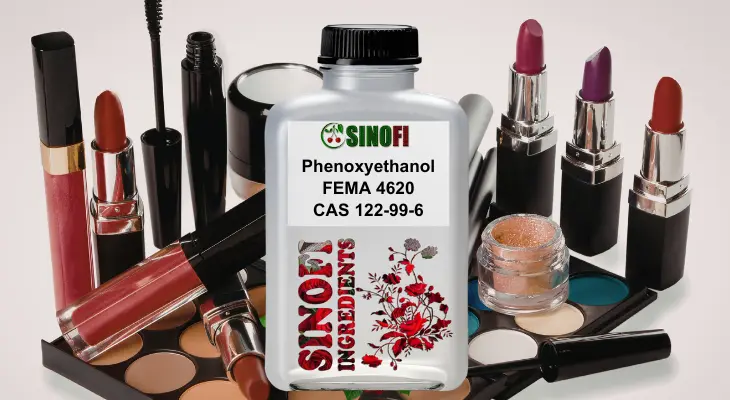
This section provides an overview of 2-phenoxyethanol, covering its manufacturing processes and regulatory status, applications in flavour, fragrance, pharmaceutical, cosmetic, and personal care industries. Also, please check out the introduction to phenoxyethanol manufacturers, supply chain issues, phenoxyethanol suppliers, and phenoxyethanol prices. Sinofi can help you buy phenoxyethanol at bulk wholesale prices based on FEMA 4620 and CAS 122-99-6.
Table of Contents
What is Phenoxyethanol?
Phenoxyethanol, chemically known as 2-phenoxyethanol, is an aromatic glycol ether produced industrially on a multi-thousand-tonne scale to serve the cosmetics, personal care, pharmaceutical, flavour, and fragrance industries. Phenoxyethanol is an aromatic ether alcohol that acts as a glycol ether. The primary role of phenoxyethanol in finished products is microbial control. It functions as a broad-spectrum preservative by disrupting the cytoplasmic membrane of microorganisms, increasing membrane permeability, and ultimately compromising cellular integrity. Its activity extends across Gram-positive bacteria, Gram-negative bacteria (including the persistently troublesome Pseudomonas aeruginosa), and a useful range of yeasts and molds. According to the U.S. Food and Drug Administration (FDA), phenoxyethanol is approved to be used in the cosmetic, flavour, and fragrance industries.
Regulatory Status and Safety Considerations
Phenoxyethanol has been evaluated by major regulatory bodies like EU SCCS, RIFM, ECHACHEM, NIST, IFRA, EPA, and OECD. It enjoys broad regulatory acceptance. The European Union, under Annex V of the Cosmetic Regulation (EC) No. 1223/2009, permits use up to a maximum concentration of 1.0% in finished cosmetic products, a position recently reaffirmed by the Scientific Committee on Consumer Safety. Similar limits apply in most major markets, including ASEAN countries, China under NMPA regulations, and Japan, while the United States allows phenoxyethanol use under standard cosmetic safety frameworks. A common and effective synergistic strategy is to combine phenoxyethanol with ethylhexylglycerin, caprylyl glycol, or organic acids. These pairings broaden the antimicrobial spectrum, particularly against fungi, while allowing each component to be used at lower concentrations. Typical effective use levels range from 0.3% to 1.0%, depending on the formulation matrix, the rest of the preservative system, and the targeted shelf-life.
Formulation Considerations
One of the principal reasons phenoxyethanol has become a workhorse preservative is its broad compatibility. It performs reliably across a pH range of approximately 3 to 10, which encompasses nearly all aqueous-based personal care systems, including shampoos, conditioners, lotions, creams, micellar waters, and emulsions. It is non-ionic, which means it does not interfere with anionic surfactants in cleansing systems or cationic actives in hair conditioners, a frequent compatibility hurdle with alternative preservatives such as parabens or quaternary biocides. Formulators should be aware that its antifungal activity is generally weaker than its antibacterial performance, which is why phenoxyethanol is most often deployed as part of a preservative blend rather than as a sole protective agent.
CAS No.: 122-99-6
According to the American Chemical Society, the CAS number of phenoxyethanol is 122-99-6.
CAS Name: 2-Phenoxyethanol
Molecular Formula: C8H10O2
Molecular Mass: 138.16
Appearance: Colourless, clear liquid.
Food Chemicals Codex Listed: No
Melting Point: 12.00 to 14.00 °C. @ 760.00 mm Hg
Boiling Point: 237.00 to 238.00 °C. @ 760.00 mm Hg
Solubility: Soluble in ether, most fixed oils, alcohol, and paraffin oil. Slightly soluble in water, 26700 mg/L @ 20 °C (exp)
Other Names:
♦ Ethanol, 2-phenoxy-
♦ 2-Phenoxyethanol
♦ Ethylene glycol monophenyl ether
♦β-Hydroxyethyl phenyl ether
♦ 1-Hydroxy-2-phenoxyethane
♦ Phenoxethol
♦ Phenoxetol
♦ Phenoxyethyl alcohol
♦ Phenoxyethanol
♦ 2-Hydroxyethyl phenyl ether
♦β-Phenoxyethyl alcohol
♦β-Phenoxyethanol
♦ 2-Phenoxyethyl alcohol
♦ Ethylene glycol phenyl ether
Phenoxyethanol Odor
Odor Strength: Medium
Substantivity: 84 hours at 100.00 %.
Odor Description: At 100.00 %. mild rose balsam cinnamyl.
FEMA Number 4620
According to the Flavour and Extract Manufacturers Association (FEMA), the FEMA number of phenoxyethanol is 4620.
Bulk Phenoxyethanol Manufacturers
The bulk phenoxyethanol manufacturing is best characterized as globally distributed yet functionally tiered. Top phenoxyethanol manufacturers like Evonik, Arkema, BASF, DOW, and Ashland leverage their integrated production platforms and global distribution networks to serve customers across all countries in the world. Asia Pacific dominated the global phenoxyethanol market in recent years, supported by abundant raw material availability, well-established manufacturing infrastructure, and proximity to high-growth personal and home care end markets. Chinese phenoxyethanol manufacturers typically compete on price, fast lead times, and flexibility on order size, although buyers must invest in quality verification, regulatory documentation review, and supplier auditing.
Sinofi is a bulk phenoxyethanol manufacturer in China, and we have a manufacturing facility with 2,500 square meters for the production of phenoxyethanol. We supply high-quality phenoxyethanol at bulk prices and serve the flavour, fragrance, pharmaceutical, cosmetic, and personal care industries worldwide.
Manufacturing Process of Phenoxyethanol
The industrial manufacture of phenoxyethanol is a mature, well-understood process built around the base-catalyzed ethoxylation of phenol. From a standpoint of synthetic chemistry, its production is a textbook example of the Williamson-type ether synthesis applied at an industrial scale, executed primarily through the catalytic ethoxylation of phenol.
Raw Materials and Feedstock Considerations
The two principal raw materials are phenol and ethylene oxide. Phenol, derived predominantly from the cumene-to-phenol process, must be supplied in high purity to avoid carryover of cresols, hydroquinone, or residual cumene hydroperoxide decomposition products that could compromise the color and odor of the final phenoxyethanol. Ethylene oxide, produced by the direct oxidation of ethylene over silver catalysts, is handled as a low-boiling, highly reactive, and toxic gas that requires specialized pressure equipment, inerting protocols, and rigorous safety engineering.
Core Reaction Chemistry
The manufacturing process proceeds via the nucleophilic addition of phenol to ethylene oxide. Under basic conditions, phenol is deprotonated to form the phenoxide anion, which then attacks the less hindered carbon of the strained three-membered ethylene oxide ring. Ring opening yields the phenoxyethoxide intermediate, which is subsequently protonated to give 2-phenoxyethanol.
Catalysis and Reaction Conditions
Industrial phenoxyethanol production typically employs basic catalysis, with sodium hydroxide, potassium hydroxide, or sodium phenoxide being the most common choices. These catalysts generate the phenoxide nucleophile in situ and accelerate the ring-opening addition. Catalyst loadings are generally maintained at low levels, typically below one percent on a molar basis, sufficient to drive the reaction without contributing excessively to side product formation or downstream neutralization burden.
Bulk Phenoxyethanol Suppliers
The bulk phenoxyethanol supply has evolved into a globally distributed, tiered ecosystem in which multinational manufacturers, regional specialists, Asian producers, and international distributors each occupy distinct strategic positions. Top phenoxyethanol suppliers like Evonik, Arkema, BASF, DOW, and Ashland typically supply premium and regulated end-use markets, offer comprehensive regulatory documentation, and are favored by multinational cosmetic and pharmaceutical brand owners that require predictable quality, global supply continuity, and audit-ready compliance packages.
Sinofi is a bulk phenoxyethanol supplier in China, and we have a warehouse with 1,200 square meters for high-quality phenoxyethanol. We sell different grades of phenoxyethanol at wholesale prices, serving end-users in the flavour, fragrance, pharmaceutical, cosmetic, and personal care industries.
Supply Chain of Phenoxyethanol
The phenoxyethanol supply chain represents a sophisticated, globally distributed network connecting petrochemical feedstock production through multiple stages of value addition to the consumer products that millions of people use every day.
Supply Chain Structure
The phenoxyethanol supply chain can be conceptualized as a five-stage value chain extending from upstream petrochemical raw materials through to finished consumer products. Each stage adds value, applies regulatory oversight, and contributes to the cost and quality profile of the final material.
- The first stage, upstream feedstock production, begins with crude oil and natural gas refining, from which the two principal raw materials for phenoxyethanol synthesis are derived. Phenol is produced predominantly through the cumene-to-phenol process, which itself depends on benzene and propylene as inputs. Ethylene oxide, the second feedstock, is produced from ethylene through silver-catalyzed direct oxidation and is supplied globally by integrated petrochemical majors.
- The second stage is phenoxyethanol manufacturing, which converts phenol and ethylene oxide into the finished active ingredient through base-catalyzed ethoxylation. This stage is dominated by tier-one multinational chemical companies
- The third stage covers distribution, warehousing, and logistics. Global chemical distributors play a critical aggregation role, sourcing material from multiple manufacturers, maintaining regional inventories, repackaging into commercially convenient formats ranging from drums to intermediate bulk containers and isotanks, and providing technical and regulatory support to buyers. Distributors are particularly important for mid-sized buyers whose volume requirements do not justify direct manufacturer relationships and for buyers seeking supply diversification across multiple production origins.
- The fourth stage is formulation and finished product manufacturing. At this point, phenoxyethanol is incorporated into finished cosmetics, personal care products, pharmaceutical preparations, paints, coatings, and industrial formulations.
- The fifth and final stage is the route to end consumers, comprising retail channels, e-commerce platforms, professional and institutional buyers, and healthcare distribution networks.
Wholesale and Buy Phenoxyethanol in Bulk
Wholesale and bulk purchasing of phenoxyethanol is a structured discipline that rewards careful preparation, supplier diversification, and total cost thinking. Phenoxyethanol buyers should define requirements precisely, qualify suppliers rigorously, negotiate contracts that balance commitment with flexibility, and maintain ongoing performance management.
Defining Bulk Procurement Requirements
Effective bulk purchasing begins with a clear internal definition of requirements. The first consideration is grade specification. Cosmetic-grade phenoxyethanol, typically meeting purity levels above 99.5 percent and conforming to industry color and odor standards, is sufficient for most personal care applications. Pharmaceutical-grade material conforming to European Pharmacopoeia, United States Pharmacopeia, or Japanese Pharmacopoeia monographs commands a premium and is necessary only for regulated drug applications. Industrial-grade material at lower purity is suitable for paints, coatings, and certain cleaning applications.
Sourcing Channels and Supplier Selection
Bulk phenoxyethanol can be purchased through three principal channels, each suited to different buyer profiles. Direct manufacturer purchasing offers the lowest unit cost and the most direct line to technical and regulatory support, but typically requires substantial annual volumes, longer lead times, and the buyer’s own logistics arrangements for international shipments.
Distributor purchasing through chemical distribution companies provides regional warehousing, smaller minimum order quantities, faster delivery, and ongoing technical support. Trading and brokerage channels, while sometimes offering attractive pricing on spot transactions, carry elevated risks around quality consistency, documentation accuracy, and supply reliability.
Supplier selection should be approached as a structured qualification exercise rather than a price-driven decision. Quality and regulatory documentation should be verified through certificates of analysis, ISO 9001, and ISO 22716 certifications.
As a bulk phenoxyethanol manufacturer and supplier in China, we wholesale this ingredient to end users in the flavour, fragrance, pharmaceutical, cosmetic, and personal care industries. We also supply phenoxyethanol to small customers. Normally, they want to buy phenoxyethanol in small quantities. To serve them, we can sell phenoxyethanol at bulk prices and provide a one-stop purchasing service.
Phenoxyethanol Prices (USD/Kg)
Cosmetic Grade Phenoxyethanol Prices (Purity >=99.5%)
| Volume | Unit Price | Shipment |
| 50g | 7 USD | Express |
| 500g | 25 USD | Express |
| 1Kg | 35 USD/Kg | Express |
| 25Kg | >=25% cheaper | Express |
| 100Kg-Above | negotiable | Express / Sea |
Cosmetic-grade phenoxyethanol (purity>=99.5%) does not have a heavily traded benchmark like ethylene oxide or phenol. Instead. It is priced at 15-35 USD/ Kg based on bilateral contracts and spot indications. Industrial-grade phenoxyethanol price trades at below 10 USD/ Kg in 200-kg drums. Normally, cosmetic-grade P5 typically commands a premium above industrial grade due to tighter phenol specification and certificate-of-analysis requirements.
Furthermore, the above phenoxyethanol price quotations do not include the express shipping fee. The reason is that the shipment cost may exceed the sample value of phenoxyethanol. However, the bulk wholesale phenoxyethanol prices will be much lower than those of small orders. Please contact us for more details.
Phenoxyethanol Specification
| Appearance | Colorless clear liquid |
| Odor: | Mild rose balsam cinnamyl |
| Purity (GC) | >=99.5% |
| Phenol (%) | <=0.001 |
| Water (%) | <=0.5 |
| Color | <=10 |
2-Phenoxyethanol Uses
Phenoxyethanol’s transition from a specialty preservative to a multi-functional industrial ingredient illustrates how favorable chemistry, broad compatibility, and a sound regulatory profile combine to drive widespread adoption across diverse markets.
Use in Cosmetics and Personal Care Industries
The largest single application area for phenoxyethanol is the cosmetics and personal care industry, where it serves primarily as a broad-spectrum preservative. Skincare products rely on phenoxyethanol to inhibit the growth of bacteria, yeasts, and molds. Hair care products similarly depend on phenoxyethanol to maintain microbiological stability across the typical shelf life of two to three years.
Colour cosmetics represent another significant application. The eye area in particular requires preservatives that combine effective antimicrobial activity with minimal irritation potential, and phenoxyethanol’s favorable safety profile makes it well-suited to this demanding application. Baby and children’s personal care products, while subject to additional regulatory scrutiny, also commonly incorporate phenoxyethanol within established concentration limits.
Use in Pharmaceutical Industry
In the pharmaceutical sector, phenoxyethanol is used both as an active ingredient and as an excipient. As an active antimicrobial, it appears in topical antiseptic formulations, wound care preparations, and certain ear drop products where its bactericidal activity contributes directly to therapeutic efficacy. Its activity against Pseudomonas aeruginosa, in particular, has made it a useful component in formulations targeting infections caused by this notoriously difficult organism.
Use in Household and Industrial Cleaning Industries
Phenoxyethanol finds extensive use across household and institutional cleaning formulations. Surface disinfectants, hand sanitizers, antibacterial wipes, and laundry products incorporate phenoxyethanol either as a primary antimicrobial agent. Its compatibility with surfactants across the full range of ionic classes, combined with its stability across the broad pH range typical of cleaning products, makes it particularly useful in this category.
Use in Paints, Coatings, and Inks Industries
Industrial applications represent a significant and stable demand base for phenoxyethanol. In water-based paints, coatings, and printing inks, phenoxyethanol serves dual functions as a coalescing solvent that aids film formation during drying and as an in-can preservative that protects the wet formulation from microbial degradation during storage.
Use in Fragrance and Flavor Industries
The fragrance industry uses phenoxyethanol both as a fragrance ingredient in its own right, contributing a faint rose-like note, and as a fixative that extends the longevity of more volatile fragrance components. Perfumes, eau de toilettes, and ambient fragrance products commonly incorporate phenoxyethanol for these purposes, often in combination with its preservative function in the finished formulation.
In some specialized food contact and flavour applications, phenoxyethanol serves as a solvent for flavour compounds, although these uses are subject to specific regulatory restrictions that vary by jurisdiction.
Veterinary and Aquaculture Applications
A specialized but commercially meaningful application of phenoxyethanol is its use as an anesthetic and sedative agent in fish aquaculture and ornamental fish handling. At controlled concentrations, phenoxyethanol induces reversible sedation in fish, facilitating handling, transport, vaccination, and minor surgical procedures while minimizing stress and physical injury. This application leverages phenoxyethanol’s specific physiological effects on aquatic organisms and represents an important tool in commercial fish farming and the ornamental fish trade.
Use in Insect Repellents
Insect repellent formulations occasionally employ phenoxyethanol as a solvent and formulation aid, helping to dissolve active ingredients such as DEET or picaridin. Specialty industrial applications include use as a chemical intermediate in the synthesis of more complex molecules, as a solvent in certain analytical and laboratory procedures.
2-Phenoxyethanol Benefits
The benefits of phenoxyethanol form a coherent and mutually reinforcing package: broad antimicrobial efficacy, exceptional formulation compatibility, favorable sensory characteristics, strong international regulatory acceptance, established safety and tolerability, paraben-free positioning, attractive economics, and practical manufacturing advantages.
Broad-Spectrum Antimicrobial Efficacy
The foundational benefit of phenoxyethanol is its broad-spectrum antimicrobial activity. It demonstrates effective inhibition of Gram-positive bacteria, Gram-negative bacteria, including the persistently challenging Pseudomonas aeruginosa, and a useful range of yeasts and molds. This breadth of activity allows a single preservative to address the majority of microbial contamination risks encountered in aqueous and emulsion-based formulations, simplifying preservative system design and reducing the number of ingredients required to achieve comprehensive microbiological protection.
Exceptional Formulation Compatibility
Phenoxyethanol’s compatibility profile is one of its most commercially valuable attributes. It functions reliably across a pH range of approximately 3 to 10, which encompasses essentially all aqueous-based personal care, cosmetic, pharmaceutical, and household formulations. This contrasts favorably with many alternative preservatives whose activity is restricted to narrower pH windows and which therefore impose constraints on the rest of the formulation.
Paraben-Free Positioning
The shift in consumer preference away from parabens began in the early 2000s and has continued steadily. As brand owners reformulated paraben-containing products to meet consumer expectations, phenoxyethanol emerged as the most practical alternative offering comparable preservative efficacy without the consumer perception challenges associated with parabens. This positioning benefit extends beyond simple substitution. Phenoxyethanol allows brands to make clear “paraben-free” claims while maintaining the preservation reliability that consumers expect, providing a meaningful marketing advantage in categories where natural and clean beauty positioning drives purchase decisions.
A Hair Mask Using 2-Phenoxyethanol
Include the following ingredients (by weight, total 100):
Hair Care Composition, 20; Glycerin, 2; Behentrimonium Chloride, 2.5; Glyceryl Stearate, 2; PEG-14M, 0.2; Cetearyl Alcohol, 6.5; Bis-Aminopropyl Dimethicone, 1.5; Cyclopentasiloxane and Dimethiconol, 2; Phenoxyethanol, 0.54; Ethylhexylglycerin, 0.06; Purified Water, rest;
Total, 100.
Hair Care Composition
Include the following ingredients (by weight, total 100):
Glutamic Acid, 5; Brassicamidopropyl Dimethylamine, 10; Panthenol, 6; Hydrolyzed Wheat Protein, 6; Phenoxyethanol, 0.3; Purified Water, rest;
Total, 100.
In conclusion, phenoxyethanol has become one of the most strategically important preservative ingredients in the personal care, pharmaceutical, and industrial chemicals supply chain. As a bulk phenoxyethanol manufacturer and supplier in China, we sell different grades of phenoxyethanol at wholesale prices to clients around the world.