




This section provides an overview of hedione (methyl dihydrojasmonate), covering its manufacturing processes and regulatory status, as well as its applications in food flavour, fragrance, detergents, fabric conditioners, soaps, and personal care industries. Also, please check out the introduction to hedione manufacturers, supply chain issues, hedione suppliers, and methyl dihydrojasmonate prices. Sinofi can help you buy hedione at bulk wholesale prices based on FEMA 3408 and CAS 24851-98-7.
Table of Contents
What is Hedione (Methyl Dihydrojasmonate)?
Hedione, trade name of methyl dihydrojasmonate, is one of the most widely produced aroma chemicals in the world. It holds an established and underappreciated position in the flavourist’s palette. Hedione is not a character-impact material in the conventional sense. Rather, it functions as a structural ingredient: a low-volatility, high-tenacity floral-fruity molecule that supplies volume, roundness, and naturalness to compositions that would otherwise present as thin, sharp, or synthetic. Discovered and characterized at Firmenich between 1957 and 1962 by Edouard Demole during work on the microconstituents of jasmine absolute, in which it occurs at approximately 0.8 per cent, the molecule was commercialized as Hedione and remained Firmenich’s largest-selling ingredient by volume as recently as 2009. Hedione is the saturated analogue: the ring-adjacent double bond of the pentenyl chain is absent, which confers markedly greater oxidative and thermal stability and makes the compound far more practical as a formulation ingredient. The material should not be confused with methyl jasmonate, the unsaturated parent compound that occurs in jasmine oil. According to the U.S. Food and Drug Administration (FDA), methyl dihydrojasmonate is approved to be used in the flavour and fragrance industries.
Regulatory Status and Safety Considerations
Methyl dihydrojasmonate has been evaluated by major regulatory bodies like JECFA, EFSA, RIFM, ECHACHEM, NIST, IFRA, and WHO. It holds FEMA GRAS status under FEMA number 3408 and has been evaluated by the Joint FAO/WHO Expert Committee on Food Additives under JECFA number 1898, with no safety concern identified at estimated levels of dietary intake as a flavouring substance. It is included in the European Union list of authorized flavouring substances under Regulation (EC) No 1334/2008; the corresponding FL number and any conditions of use should be confirmed against the current consolidated Union list at the time of dossier preparation.
Acute toxicity is low, with reported oral LD₅₀ values in the rat and dermal LD₅₀ values in the rabbit both in excess of 5 g/kg. The material is not classified as a hazardous substance under normal handling conditions, although eye contact should be avoided. The applicable supplier safety data sheet remains the governing document for occupational handling.
For any application that also carries a fragrance function, the current IFRA Standards and Transparency List should be consulted directly, since restriction status is subject to periodic revision.
Sensory Profile
At full strength, the material is floral and jasmine-like, with a soft, oily-fatty undertone, a green edge, and a distinctly lactonic and lightly tropical character. It is remarkably transparent for a base note: it adds body without adding weight or muddiness. On dilution, the jasmine facet recedes, and a diffusive, radiant, slightly citrus-floral quality emerges. Cis-enriched grades are denser, more magnolia-like, and considerably more powerful; recognition thresholds in the region of fifteen parts per billion have been reported for epimerised mixtures. In application, the material reads as floral, fruity, and faintly creamy, with a smooth mouth-coating quality and a long, clean finish. It is not sweet in the sense of vanillin or ethyl maltol, but it enhances perceived sweetness indirectly by lengthening the fruity impression and softening acidic bite.
It links volatile ester top notes to lactonic and heavy floral bodies, closing the perceptual gap that otherwise makes a fruit flavour read as two disconnected layers. It also rounds off the harshness of aldehydes and of high-impact esters, and it contributes the diffusive quality that panellists typically describe as “natural”, “juicy”, or “ripe”.
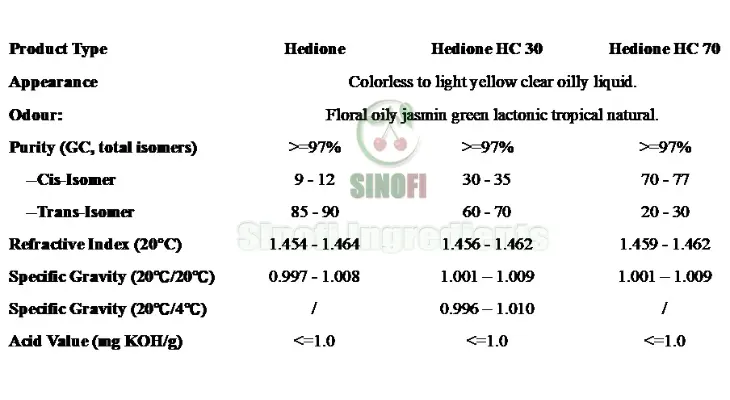
For the formulation engineer, the material presents two distinctive technical features that must be understood before it can be deployed reliably. The first is that its odour strength is governed almost entirely by the ratio of its diastereoisomers rather than by its assay purity. The second is that this ratio is not fixed; the relevant stereocentre is epimerizable, which has direct consequences for shelf life and behaviour in acidic matrices. The single most consequential variable in MDJ procurement is the ratio of cis to trans isomers. The cis isomer carries substantially greater olfactory strength and radiance, and grades are priced accordingly. Commercially available materials span a wide range, and the following figures, widely cited within the perfumery community and drawn from academic and trade sources, should be treated as indicative rather than as contractual specifications.
| Trade name | Producer | Approximate Cis:Trans Ratio |
| Hedione | DSM-Firmenich | 10:90 |
| Cepionate | Zeon | 30:70 |
| Kharismal | IFF | 60:40 |
| Super Cepionate | Zeon | 70:30 |
| Jasmodione | Takasago | 70:30 |
| Kharismal Super | IFF | 72:28 |
| Hedione HC | DSM-Firmenich | 75:25 |
| Hedione VHC | DSM-Firmenich | 90:10 |
| Paradisone | DSM-Firmenich | 94:6 |
Natural Occurrence
The compound has been identified in tea and in certain honeys, including pine and rhododendron honeys. Its unsaturated relative, methyl jasmonate, is a genuine constituent of jasmine absolute.
CAS No.: 24851-98-7
According to the American Chemical Society, the CAS number of Hedione is 24851-98-7.
CAS Name: Hedione
Molecular Formula: C13H22O3
Molecular Mass: 226.31
Appearance: Colorless to light yellow clear oily liquid.
JECFA Number: 1898
Food Chemicals Codex Listed: No
Boiling Point: 109.00 to 112.00 °C. @ 0.20 mm Hg
Solubility: Soluble in alcohol, isopropyl myristate, propylene glycol; insoluble in water.
Other Names:
♦ Cyclopentaneacetic acid, 3-oxo-2-pentyl-, methyl ester
♦ Methyl (2-pentyl-3-oxocyclopentyl)acetate
♦ Kharismal
♦ Hedione
♦ Methyl (3-oxo-2-pentylcyclopentyl)acetate
♦ MDJ
♦ 2-[3-Oxo-2-(pentan-1-yl)cyclopentyl]acetic acid methyl ester
♦ Dihydrojasmonic acid methyl
♦ Methyl 2-(3-oxo-2-pentylcyclopentyl)acetate
♦ Methyl 2-(3-oxo-2-pentylcyclopentyl)ethanoate
Hedione Odor
Odor Strength: Medium.
Substantivity: 72 hours at 100.00 %.
Odor Description: At 100.00 %, floral, oily, jasmin green, lactonic, tropical, natural.
FEMA Number 3408
According to the Flavour and Extract Manufacturers Association (FEMA), the FEMA number of methyl dihydrojasmonate is 3408.
Bulk Hedione Manufacturers
The number of hedione manufacturers worldwide is small relative to the number of entities presenting themselves online as producers. Top hedione manufacturers like Firmenich, Symrise, IFF, Givaudan, Takasago, Mane, ZEON, Lluch Essence and NHU maintain large in-house synthesis capability. Their output is substantially captive, consumed inside their own compound business. Merchant availability is selective and frequently routed through authorized distributors rather than sold directly in bulk. Chinese methyl dihydrojasmonate manufacturers anchor the standard-grade merchant market. Competitive advantages here are cost, drum-to-ISO-tank flexibility, and short lead times into Asian markets.
Sinofi is a bulk hedione manufacturer in China, and we have a manufacturing facility with 2,500 square meters for the production of methyl dihydrojasmonate. We supply high-quality hedione at bulk prices and serve food flavour, fragrance, detergents, fabric conditioners, soaps, and personal care industries worldwide.
Manufacturing Process of Hedione (Methyl Dihydrojasmonate)
Six decades after its introduction, hedione is still made by a route that a synthetic chemist would recognize instantly: an aldol condensation, an isomerisation, a conjugate addition, and a decarboxylation. The durability of that route reflects genuine elegance — cheap feedstocks, short sequence, no protecting groups, no precious metals — and its refinement has been a matter of incremental engineering rather than reinvention: better catalysts for each step, tighter thermal control in the decarboxylation, and distillation trains capable of meeting an olfactory rather than merely a chromatographic specification.
Raw Materials
Three feedstocks dominate the cost structure:
- Cyclopentanone, conventionally obtained by cyclisation and decarboxylation of adipic acid or its esters, or by oxidation of cyclopentene from steam-cracker C5 streams. A renewable pathway via the aqueous-phase hydrogenative rearrangement of furfural has attracted considerable attention and offers a credible route to bio-based MDJ.
- n-Valeraldehyde (pentanal), produced industrially by the hydroformylation of 1-butene. Isomeric purity matters: carryover of 2-methylbutanal generates branched homologues that persist through the entire sequence and dilute the odour value of the final product.
- Dimethyl malonate, supplied by carbonylation of methyl chloroacetate or by methanolysis of malononitrile-derived intermediates. It is used in substantial excess and recovered by distillation for recycle, so the net consumption factor is far lower than the charge ratio implies.
Dominant Industrial Route
The principal industrial route proceeds from cyclopentanone and n-valeraldehyde by aldol condensation followed by acid-catalyzed isomerization to the key intermediate 2-pentyl-2-cyclopentenone, which then undergoes addition of dimethyl malonate and decarboxylation to furnish methyl dihydrojasmonate.
Bulk Hedione Suppliers
The bulk supply of hedione divides into three tiers, and the tier a buyer engages should follow directly from volume, grade requirement, and internal technical capability. Top hedione suppliers like Firmenich, Symrise, IFF, Givaudan, Takasago, Mane, ZEON, Lluch Essence, and NHU manufacture branded Hedione grades and control the high-cis segment. They offer the deepest technical support, complete regulatory dossiers, and the broadest grade portfolios, including proprietary high-cis materials with no direct substitutes. Chinese hedione suppliers focus on the standard-grade material destined for detergents, fabric conditioners, soaps, and mass personal care. Many small distributors serve smaller buyers and provide geographic reach.
Sinofi is a bulk hedione supplier in China, and we have a warehouse with 1,200 square meters for high-quality methyl dihydrojasmonate. We sell different grades of methyl dihydrojasmonate at wholesale prices, serving end-users in food flavour, fragrance, detergents, fabric conditioners, soaps, and personal care industries.
Supply Chain of Hedione (Methyl Dihydrojasmonate)
Methyl dihydrojasmonate occupies an unusual position in specialty chemicals. It is simultaneously a fine-fragrance material of considerable artistic importance and a high-tonnage functional commodity, consumed at estimated global volumes on the order of 20,000 metric tonnes per annum. Three structural characteristics define the value chain and should frame any commercial assessment:
A Narrow Upstream Neck
Essentially all commercial MDJ derives from a single industrial route dependent on two merchant intermediates — cyclopentanone and n-valeraldehyde — neither of which is produced primarily for the fragrance industry. MDJ producers are therefore price-takers on inputs whose economics are set by nylon, plasticizer and oxo-alcohol markets.
A Stereochemical Value Ladder
The commercially decisive variable is not purity but cis-isomer content. The cis diastereomer possesses an odour detection threshold roughly twenty to seventy times lower than the trans form, and the ability to enrich and stabilise it constitutes the principal technological moat in the midstream.
Extreme Buyer Concentration
A small number of global fragrance houses account for the majority of offtake, and they are simultaneously the largest captive producers. Merchant suppliers consequently sell into a market where their principal customers are also their principal competitors.
Wholesale and Buy Hedione in Bulk
Methyl dihydrojasmonate has earned its position as one of the most widely used materials in the perfumer’s palette, and its importance makes it a natural candidate for structured wholesale procurement. Hedione buyers should define a clear specification, qualify more than one reliable source, secure volume through sensible contracts, and manage storage and documentation.
Defining the Specification
Methyl dihydrojasmonate is a synthetic aroma chemical belonging to the jasmonate family. Commercial supply is dominated by a small number of large aroma chemical producers, with additional capacity from established manufacturers in Asia. The material is typically offered at a gas chromatography purity of 98% or higher. Buyers should also be aware that methyl dihydrojasmonate exists as a mixture of isomers, and that grades enriched in the cis isomer command a substantial premium because the cis form carries most of the odor impact. Standard grades are appropriate for most applications, while cis-enriched qualities are generally reserved for fine fragrance work where olfactive performance justifies the cost.
Each delivery should be accompanied by a certificate of analysis tied to the batch number, a current safety data sheet, and supporting regulatory documentation, including confirmation of IFRA standard conformity and allergen declarations. Suppliers serving the personal care sector should also be able to provide statements on residual solvents, heavy metals, and applicable certifications such as ISO 9001.
Commercial Case for Buying in Bulk
Purchasing hedione in wholesale quantities delivers advantages on several fronts. The first is unit economics. The price gap between kilogram-scale purchases from resellers and drum or pallet quantities from manufacturers or authorized distributors is considerable, and for a material dosed as heavily as this one, the savings compound quickly across a production year.
Evaluating and Qualifying Suppliers
Wholesale buyers generally choose between purchasing directly from manufacturers and working through authorized distributors. Direct manufacturer relationships offer the best pricing at high volumes and clearer visibility into production planning, but they usually carry higher minimum order quantities. Qualification should follow a consistent process. Request pre-shipment samples and evaluate them both analytically and olfactively against your reference standard. Verify the supplier’s regulatory standing and, for significant volumes, consider a quality audit or, at minimum, a detailed supplier questionnaire.
As a bulk hedione manufacturer and supplier in China, we wholesale this ingredient to end users in food flavour, fragrance, detergents, fabric conditioners, soaps and personal care industries. We also supply hedione to small customers. Normally, they want to buy methyl dihydrojasmonate in small quantities. To serve them, we can sell hedione at bulk prices and provide a one-stop purchasing service.
Hedione (Methyl Dihydrojasmonate) Prices (USD/Kg)
Food Grade Hedione Prices (GC, total isomers >=97.0%, cis>=10.0%)
| Volume | Unit Price | Shipment |
| 50g | 6 USD | Express |
| 500g | 32 USD | Express |
| 1Kg | 42 USD/Kg | Express |
| 25Kg | 31 USD/Kg | Express |
| 100Kg | 29 USD/Kg | Express / Sea |
| 200Kg-Above | negotiable | Express / Sea |
Standard-grade Hedione (approximately 10% cis-isomer content, approved for food and fragrance applications) is priced at USD 20–50 per kilogram. Volume-based pricing is available for liquid detergent manufacturers placing orders of 5 metric tons or more, with unit prices reduced to USD 10 per kilogram. Premium high-cis Hedione variants—such as Cepionate (~30% cis-isomer)—are commercially available in the range of USD 50–120 per kilogram. Hedione HC (≥70% cis-isomer), a leading premium-grade material, commands a price range of USD 150–300 per kilogram. This grade is distinguished by its enhanced olfactive bloom and superior diffusion characteristics; however, its relatively low chemical stability—evidenced by cis-to-trans isomerization under acidic or alkaline conditions—restricts its applicability in functional home-care formulations.
Furthermore, the above price quotations of hedione do not include the express fee. This is because the shipping cost may exceed the sample value of methyl dihydrojasmonate. However, the bulk wholesale prices of hedione will be much lower than those of small orders. Please contact us for more details.
Methyl Dihydrojasmonate Specification
Hedione (Methyl Dihydrojasmonate) Uses
Methyl dihydrojasmonate occupies an unusual position in the perfumer’s palette. It is not a signature material, and consumers almost never identify it. Its importance is structural: it floralizes, diffuses, smooths, fixes, and renders compositions transparent, all while tolerating the alkaline and thermal insults of functional product bases and remaining inexpensive enough to use in bulk. Formulators should note an important practical constraint. The cis configuration is thermodynamically disfavoured and tends to isomerise back toward the trans form over time, particularly outside a near-neutral pH range. High-cis grades therefore have a shorter effective shelf life and are largely restricted to fine fragrance and neutral-pH personal care, whereas standard grade is the appropriate choice for alkaline or acidic bases. High-cis material should be stored cool, dark, and tightly sealed.
Applications in Flavour
In flavour formulation, hedione is a supporting material used at fractional percentages of the compound. Published FEMA usual and maximum use levels should be consulted for each food category, and the figures below represent ordinary formulation practice.
- Jasmine, green tea, black tea, oolong: Core floral character and tea-leaf persistence.
- Stone fruit – peach, nectarine, apricot, plum: Floral lift and natural rounding of the lactone-ester core.
- Berry – strawberry, raspberry: Floral top-fill and reduction of confectionery flatness.
- Tropical – lychee, guava, passion fruit, mango: Floral-perfumed authenticity.
- Muscat grape, elderflower, rose: Direct floral contribution.
- Honey and floral dairy: Waxy-floral persistence.
- Botanical spirits and vermouth profiles: Floral bridge and length.
Applications in Fine Fragrance
Within fine fragrance, the molecule performs several distinct functions, often simultaneously.
Floralization.
It supplies a clean jasmine–magnolia character that can be built into jasmine accords without the heaviness of indole, or used to add a floral dimension to compositions that are not nominally floral at all, including citrus colognes, fougères and woody-amber structures.
Diffusion and Volume.
The material projects unusually well and lifts the volatile top and heart notes with which it is combined. Perfumers speak of the “bloom” it confers: an impression that the fragrance occupies more space than its concentration would suggest.
Blending and Smoothing.
Perhaps its most important role is as a connective tissue. It rounds the abrasive edges of aldehydes, sharp citrus materials and certain synthetics, and bridges the perceptual gap between top and heart, producing a seamless development rather than a sequence of discrete stages.
Transparency
In modern florals, aquatic and marine accords, clean musks and fresh masculine constructions, the material is the primary means of achieving the watery, airy, skin-adjacent quality that defines the genre.
Semi-fixation and Dilution.
Its low volatility extends the life of the composition, while its low odour intensity allows it to serve as a partial diluent or bulking agent that contributes rather than merely fills.
Typical usage in the fragrance concentrate runs from around 2 to 15 per cent. Jasmine-forward or deliberately transparent compositions routinely exceed 30 per cent, and levels above 40 per cent are documented. High-cis grades achieve comparable effects in the range of roughly 7 to 25 per cent.
Applications in Functional and Personal Care Products
The material’s technical robustness makes it at least as important in functional perfumery as in fine fragrance.
Soap and Detergents
Good stability in alkaline media allows use in bar soap, powder detergents and laundry liquids, where many floral materials discolour or degrade. It survives the saponification environment and contributes a fresh floral lift that reads as cleanliness.
Fabric Care
Low volatility combined with low water solubility gives the molecule useful substantivity on textiles, so it deposits and persists through rinsing and drying. This makes it a common component of fabric conditioners and laundry perfumes.
Rinse-off and Leave-on Personal Care
Shampoos, conditioners, shower gels, deodorants, antiperspirants, lotions, wipes, and cosmetic formulations all use the material for floral character and diffusion. Standard grade is preferred where the base pH departs from neutral.
Household and Hard-surface Cleaners
It is used in all-purpose cleaners and surface sprays, though formulators should confirm compatibility where oxidising bleach systems are involved.
Air Care and Candles
A boiling point above 300 °C and a flash point around 113 °C give good thermal stability, supporting use in scented candles, wax melts, reed diffusers, aerosols and gel air fresheners. The same low volatility that aids substantivity means that in reed diffusers the material remains in the reservoir longer than lighter components, a factor worth accounting for in evaporation balance.
Ancillary and Research Applications
Beyond perfumery, the material has a small number of secondary uses. It is listed as an inert ingredient for certain non-food pesticide formulations, and it appears at trace levels in some flavour and tobacco applications, though such use is jurisdiction-dependent and subject to the relevant food and tobacco regulations rather than fragrance standards.
Hedione (Methyl Dihydrojasmonate) Benefits
Methyl dihydrojasmonate earns its position in the perfumer’s palette through a rare combination of attributes: radiance and diffusion, a harmonising effect on surrounding materials, extraordinary dosage latitude, robust stability across cosmetic and household bases, secure and economical supply, and an uncomplicated regulatory profile.
Radiance and Diffusion
The most valued attribute of methyl dihydrojasmonate is its capacity to enlarge a composition without weighing it. The material projects outward, creating what perfumers describe as an aura or halo effect around the wearer. A formula that reads as flat or compressed on the strip will often gain immediate lift when the material is introduced. This benefit is difficult to replicate with other ingredients, and it explains why the molecule remains standard in fine fragrance even after six decades of subsequent innovation.
Blending and Harmonizing Capacity
Methyl dihydrojasmonate functions as a connective agent within a formula. It softens abrupt transitions between top and heart, rounds the sharp edges of aldehydes and citrus terpenes, and lends coherence to accords whose components would otherwise sit awkwardly together. In practical terms, it reduces the number of corrective adjustments required during development and shortens the path from a promising trial to a finished submission.
Hedione (Methyl Dihydrojasmonate) in E-Liquid and Vaping Products
Methyl dihydrojasmonate is one of the most heavily produced aroma chemicals in the world. Its position in the electronic nicotine delivery system (ENDS) sector is considerably less settled. The substance appears in supplier catalogues that serve both perfumery and do-it-yourself e-liquid mixing; it holds food-flavouring clearances in several jurisdictions, and it offers a jasmine-tea character that is otherwise difficult to construct.
A Jasmine Tea Flavouring Formulation Using Hedione
Include the following ingredients (by weight, total 100g):
Cis-3-hexenol: 1; Linalool: 0.5; Phenethyl Alcohol: 0.8; Alpha-Amylcinnamaldehyde: 2; Hexanal: 0.5; Benzyl Acetate: 0.5; Jasmine Absolute: 3; Neroli Oil: 0.5; Cis-3-Hexenyl Acetate: 0.5; Indole: 3; Geraniol: 1; Geranyl Acetate: 0.5; Linalyl Acetate: 0.3; Methyl Dihydrojasmonate: 3; Farnesol: 0.5; Alpha-Terpineol: 0.6; Beta-Damascone: 0.2; Beta-Ionone: 0.2; Benzyl Alcohol: 0.08; Cis-3-Hexenyl Benzoate: 0.05; Ethyl Maltol: 0.3; Methyl Anthranilate: 0.5; Methyl Benzoate: 0.05; Methyl Salicylate: 0.1; Ethanol: 80.32.
In conclusion, methyl dihydrojasmonate is a high-volume, well-studied aroma chemical which is widely used in food flavour, fragrance, detergents, fabric conditioners, soaps and personal care industries. As a bulk hedione manufacturer and supplier in China, we sell different grades of methyl dihydrojasmonate at wholesale prices to clients around the world.