




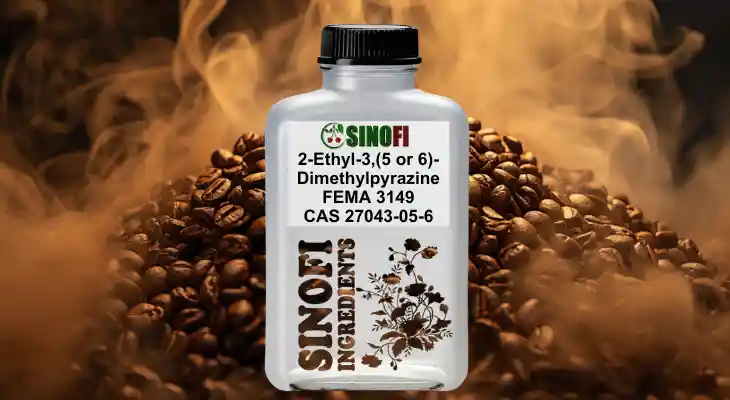
This section provides an overview of 2-ethyl-3,(5 or 6)-dimethylpyrazine, covering its manufacturing processes and regulatory status, applications in food, flavour, fragrance, cosmetic, and personal-care industries. Also, please check out the introduction to 2-ethyl-3,(5 or 6)-dimethylpyrazine manufacturers, supply chain issues, 2-ethyl-3,(5 or 6)-dimethylpyrazine suppliers, and 2-ethyl-3,(5 or 6)-dimethylpyrazine prices. Sinofi can help you buy 2-ethyl-3,5(6)-dimethylpyrazine at bulk wholesale prices based on FEMA 3149 and CAS 27043-05-6.
Table of Contents
What is 2-Ethyl-3,(5 or 6)-Dimethylpyrazine?
2-Ethyl-3,(5 or 6)-dimethylpyrazine is a heterocyclic, nitrogen-containing compound prized for its characteristic roasted odour and flavour, reminiscent of roasted cocoa and nuts. It is, in fact, a mixture of two positional isomers rather than a single defined chemical entity. It comprises 2-ethyl-3,5-dimethylpyrazine and 2-ethyl-3,6-dimethylpyrazine, which explains the “(5 or 6)” notation that appears throughout the flavour literature. These are typically supplied together in an approximate ratio of sixty parts of the 3,5-isomer to forty parts of the 3,6-isomer. This distinction is important in procurement and specification work: the individual isomer, 2-ethyl-3,5-dimethylpyrazine, has its own identifiers (CAS 13925-07-0; FEMA 3150), whereas the commercially traded isomeric mixture is the substance addressed here. Structurally, the molecules of 2-ethyl-3,5-dimethylpyrazine and 2-ethyl-3,6-dimethylpyrazine consist of a pyrazine ring, which is a six-membered aromatic ring containing two nitrogen atoms in non-adjacent positions, bearing one ethyl substituent and two methyl substituents. According to the U.S. Food and Drug Administration (FDA), 2-ethyl-3,(5 or 6)-dimethylpyrazine is approved to be used in the flavour and fragrance industries.
The principal regulatory and structural descriptors are as follows:
- Chemical name: 2-ethyl-3,(5 or 6)-dimethylpyrazine (mixture of isomers)
- CAS number: 27043-05-6
- FEMA number: 3149
- JECFA number: 775
- Council of Europe number: 2246
- FLAVIS (EU) number: 14.100
- EINECS number: 237-694-1
Numerous synonyms circulate in supplier catalogues, including 2,6-dimethyl-3-ethylpyrazine, 3,5-dimethyl-2-ethylpyrazine, dimethylethylpyrazine, and the trade descriptor “cocoa pyrazine.” Care should be taken to match the CAS number and FEMA number rather than relying on synonyms alone, given the close structural family and the frequent conflation of the mixture with its single-isomer relatives.

Regulatory Status and Safety Considerations
2-Ethyl-3,(5 or 6)-dimethylpyrazine has been evaluated by major regulatory bodies like JECFA, EFSA, ECHACHEM, IFRA, WHO and Regulatory Toxicology and Pharmacology. The substance benefits from a well-established regulatory position. Its direct addition to food has been determined to be Generally Recognised as Safe (GRAS) by the Flavour and Extract Manufacturers Association (FEMA), under FEMA number 3149. According to Eur-Lex, EU has provisionally approved it as a flavouring agent for foods and beverages (No. 14.100), and it has been reviewed within the framework of the Joint FAO/WHO Expert Committee on Food Additives (JECFA). Where the material is used in fragrance applications, suppliers indicate adherence to the guidelines of the International Fragrance Association (IFRA). Notwithstanding its safety as a food flavouring, the concentrated raw material warrants standard occupational precautions.
Sensory Profile
The defining attribute of this ingredient is its powerful roasted character. Descriptors commonly assigned to it include roasted, nutty, cocoa, chocolate, hazelnut, peanut, coffee, and earthy notes. This profile positions it as a bridge between the toasted, Maillard-derived top notes of a formulation and its deeper, roasted base.
Typical applications include:
- Coffee, cocoa, and chocolate flavour systems
- Roasted nut and peanut flavours
- Baked goods, cereal, and snack seasonings
- Savory applications such as grilled, roasted meat, and potato notes
- Tobacco flavouring and select fragrance accords
Natural Occurrence and Formation
This pyrazine is not an artificial curiosity but a naturally occurring constituent of a wide array of cooked and roasted foods. It has been reported in cocoa products, coffee, roasted nuts (including peanuts, filberts, and pecans), cooked beef, fried pork, Swiss cheese, roasted barley, malt, popcorn, corn and corn tortillas, cooked potato, soy products, cooked shrimp, beer, rum, whiskey, and cured tobacco. It has also been identified as a key aroma contributor in certain teas.
Its genesis in food is chiefly through the Maillard reaction, the cascade of reactions between amino acids and reducing sugars that occurs during thermal processing, together with the pyrolysis of amino acids such as serine and threonine. Because these reactions are effectively unavoidable during cooking, alkylpyrazines of this type are routinely present in the everyday diet. As a biological point of interest beyond the food context, this compound has also been identified as a component of the alarm pheromone of the fire ant, Solenopsis invicta, illustrating the broad natural distribution of the pyrazine motif.
CAS No.: 27043-05-6
According to the American Chemical Society, the CAS number of 2-ethyl-3,(5 or 6)-dimethylpyrazine is 27043-05-6.
CAS Name: 2-Ethyl-3,?-dimethylpyrazine
Molecular Formula: C8H12N2
Molecular Mass: 136.20
Appearance: Colourless to light yellow, clear liquid.
JECFA Number: 775
Food Chemicals Codex Listed: No
Boiling Point: 180 °C. @ 760.00 mm Hg
Solubility: soluble in ethanol, organic solvents; slightly soluble in water 1473 mg/L @ 25 °C (est.).
Other Names:
♦ Pyrazine, 2-ethyl-3,?-dimethyl-
♦ 2-Ethyl-3,?-dimethylpyrazine
♦ 2-Ethyl-3,(5 or 6)-dimethylpyrazine
♦ 2-Ethyl-3,5(6)-dimethylpyrazine
2-Ethyl-3,(5 or 6)-Dimethylpyrazine Odor
Odour Strength: Strong.
Odour Description: At 0.10 % in dipropylene glycol, burnt coffee, nutty, roasted, woody.
FEMA Number 3149
According to the Flavour and Extract Manufacturers Association (FEMA), the FEMA number of 2-ethyl-3,(5 or 6)-dimethylpyrazine is 3149.
Bulk 2-Ethyl-3,(5 or 6)-Dimethylpyrazine Manufacturers
2-Ethyl-3,(5 or 6)-dimethylpyrazine is a low-volume speciality flavour pyrazine. The global base of qualified manufacturers is comparatively narrow and is concentrated among aromatic-chemical and custom-synthesis firms in China, Germany, UK and North America. Top 2-ethyl-3,(5 or 6)-dimethylpyrazine manufacturers like Sigma-Aldrich, TCI, Firmenich, Lluch Essence, Ernesto Ventos, and Givaudan emphasize technical support, regulatory compliance, and supply reliability over pure cost competition. China dominates global synthetic pyrazine capacity. It alone represents nearly 40% of global pyrazine production capacity, benefiting from strong domestic demand and export opportunities.
Sinofi is a bulk manufacturer of 2-ethyl-3,(5 or 6)-dimethylpyrazine in China, and we have a manufacturing facility with 2,500 square meters for the production of 2-ethyl-3,5(6)-dimethylpyrazine. We supply high-quality 2-ethyl-3,(5 or 6)-dimethylpyrazine at bulk prices and serve food, flavour, and fragrance industries worldwide.
Manufacturing Process of 2-Ethyl-3,(5 or 6)-Dimethylpyrazine
2-Ethyl-3,(5 or 6)-dimethylpyrazine is normally supplied as a binary mixture of two positional isomers—2-ethyl-3,5-dimethylpyrazine and 2-ethyl-3,6-dimethylpyrazine—rather than as a single pure compound. The material is a heterocyclic aromatic amine built on the pyrazine ring, a six-membered ring bearing nitrogen atoms at the 1- and 4-positions.
Principal Manufacturing Route: Diamine–Dicarbonyl Condensation and Dehydrogenation
For 2-ethyl-3,(5 or 6)-dimethylpyrazine, the two-step condensation–dehydrogenation sequence is the route that most naturally accounts for both the substitution pattern and the characteristic isomeric mixture.
Choice of Building Blocks
The pyrazine ring may be viewed as the union of two two-carbon–nitrogen fragments. One fragment supplies the adjacent ethyl and methyl groups at ring positions 2 and 3; the other supplies the remaining methyl group and hydrogen.
Condensation to the Dihydropyrazine
In the first step, the diamine and diketone are combined in an inert solvent such as diethyl ether or a lower alcohol, generally at reduced temperature to moderate the exothermic condensation and to suppress side reactions. The two primary amine groups condense with the two carbonyl groups, each forming an imine (Schiff base) with loss of water. Ring closure furnishes a 5,6-dihydropyrazine intermediate bearing the full complement of alkyl substituents.
Origin of the (5 or 6)-Isomer Mixture
The defining feature of this product—and the reason for the “(5 or 6)” nomenclature—arises directly from the use of an unsymmetrical diamine. Because 1,2-diaminopropane bears its methyl group on only one of the two aminated carbons, each amine terminus may pair with either carbonyl of the diketone during ring formation. The two productive orientations place the methyl group at either position 5 or position 6 of the resulting ring.
Dehydrogenation (Aromatization)
The dihydropyrazine intermediate is next aromatized to the fully conjugated pyrazine. This is achieved by catalytic dehydrogenation, classically over copper chromite (copper–chromium oxide) and, in more modern practice, over supported copper, palladium, or related transition-metal catalysts.
Vapor-Phase Catalytic Condensation
A closely related industrial philosophy replaces the reactive α-diketone with the corresponding vicinal diol and performs both condensation and dehydrogenation in a single high-temperature, vapor-phase operation. In the analogous preparation of methylpyrazine, ethylenediamine and propylene glycol are passed over a metal-oxide catalyst—historically zinc oxide, and more recently copper–zinc–chromium, silver-containing, or other engineered formulations—at elevated temperature.
Bulk 2-Ethyl-3,(5 or 6)-Dimethylpyrazine Suppliers
The supply for 2-ethyl-3,(5 or 6)-dimethylpyrazine exemplifies the speciality flavour-ingredient model: a low-volume, high-value molecule supported by a narrow manufacturing base. Top 2-ethyl-3,(5 or 6)-dimethylpyrazine suppliers like Sigma-Aldrich, TCI, Firmenich, Lluch Essence, Ernesto Ventos, and Givaudan supply this aromatic chemical with an extensive documentation package that typically includes SDS, specifications, Kosher and Halal certificates, and a suite of regulatory statements covering allergens and IFRA compliance.
Sinofi is a bulk 2-ethyl-3,(5 or 6)-dimethylpyrazine supplier in China, and we have a warehouse with 1,200 square meters for high-quality 2-ethyl-3,5(6)-dimethylpyrazine. We sell different grades of 2-ethyl-3,(5 or 6)-dimethylpyrazine at wholesale prices, serving end-users in food, flavour, and fragrance industries.
Supply Chain of 2-Ethyl-3,(5 or 6)-Dimethylpyrazine
The supply chain of 2-ethyl-3,(5 or 6)-dimethylpyrazine exhibits the structural complexity typical of fine and speciality chemicals: concentrated upstream feedstock dependence, a limited base of qualified manufacturers, stringent regulatory and quality gatekeeping, and a distribution network organized around flavour houses and food manufacturers.
Supply Chain Structure
The supply chain for this ingredient can be understood as a multi-tier structure progressing from basic chemical feedstocks through synthesis, purification, quality certification, formulation, and finished-goods manufacturing.
Raw Materials and Feedstocks
The upstream foundation of the supply chain comprises the basic organic building blocks required for pyrazine synthesis, together with the reagents, catalysts, and solvents consumed during manufacturing. Alkylpyrazines are generally accessed through condensation chemistry involving carbonyl and amine precursors, which are themselves derived from petrochemical and bulk-chemical value chains.
Manufacturing
The manufacturing tier is the strategic core of the supply chain and its principal bottleneck. Production of the isomeric mixture requires specialized synthetic capability, process control to manage isomer distribution and impurity profiles, and purification infrastructure adequate to meet food-grade specifications.
Distribution and Trading
Given the low unit volumes and the fragmented, geographically dispersed nature of demand, distributors and speciality chemical traders play a central intermediary role. These participants aggregate supply, hold inventory, provide repackaging into commercially convenient quantities, and manage the logistics and documentation associated with cross-border movement of a regulated food ingredient. For many small and mid-sized buyers, distributors are the practical point of access to the material, and the distributor relationship often carries responsibility for continuity of supply and regulatory paperwork.
Flavour Formulation
Flavour houses represent the principal industrial consumers of the ingredient. Within this tier, the compound is incorporated at trace levels into proprietary flavour systems designed to deliver targeted roasted, nutty, or savory profiles. The flavour houses possess the formulation expertise, sensory evaluation capability, and application knowledge required to translate a potent single molecule into a stable, reproducible commercial flavour.
Wholesale and Buy 2-Ethyl-3,(5 or 6)-Dimethylpyrazine in Bulk
2-Ethyl-3,(5 or 6)-dimethylpyrazine is a high-impact, low-dosage workhorse for roasted, nutty, and cocoa flavour creation, and its procurement rewards a disciplined approach. Purchasing managers should demand complete specifications, qualify suppliers rigorously, and structure bulk agreements around consistency and continuity rather than price alone. For organizations with steady demand, wholesale purchasing is not merely a cost decision. It is a quality and risk management strategy.
Market Demand and Why Bulk Buying Makes Sense
Demand for roasted and savory flavour profiles has remained resilient across snack foods, plant-based proteins, ready-to-drink coffee, and confectionery. For a flavour house or food manufacturer with recurring formulations, spot purchasing in kilogram quantities quickly becomes uneconomical. Wholesale procurement offers several advantages:
- Unit cost reduction. Price breaks between 1 kg, 25 kg, and 180–200 kg drum quantities are substantial for speciality pyrazines. Annual contract pricing can further stabilize costs against raw material volatility.
- Supply continuity. Speciality aroma chemicals are produced in campaigns rather than continuously. Securing volume commitments ensures allocation during tight production cycles.
- Batch consistency. Purchasing larger lots from a single production batch reduces the analytical burden of qualifying multiple lots and minimizes sensory drift across finished flavour batches.
Specifications to Require Before Purchase
Before committing to a bulk order, I insist on complete documentation from every prospective supplier. At a minimum, request the following:
- Certificate of Analysis (CoA) for the specific lot, including assay (typically ≥ 98% by GC, sum of isomers), appearance, refractive index, and specific gravity.
- Isomer ratio disclosure. Because the material is a mixture of the 3,5- and 3,6-dimethyl isomers, the ratio can affect sensory character. Consistency of the ratio lot to lot matters more than the absolute value.
- Regulatory documentation, including FEMA GRAS status (FEMA 3149), compliance statements for the relevant jurisdictions (for example, FDA, EU flavouring regulation), kosher and halal certificates where required, and allergen, GMO, and natural or synthetic status declarations.
- Safety Data Sheet (SDS) current to the destination market’s format.
- Food-grade manufacturing credentials, such as FSSC 22000, ISO 9001, or equivalent GMP certification of the production site.
Evaluating Wholesale Suppliers
The global supply base for this compound includes dedicated aroma chemical manufacturers and speciality distributors, with significant production capacity in China, India, Europe, and the United States. When qualifying a new source, I recommend the following process:
- Sample and pilot evaluation. Begin with an analytical and sensory evaluation of a retained sample against your current benchmark. GC-MS comparison and triangle testing by the flavour team should precede any commercial commitment.
- Site and quality audit. For strategic volumes, conduct a documentation audit at a minimum and an on-site or third-party audit when annual spend justifies it.
- Dual sourcing. Qualify at least two suppliers for any pyrazine that is critical to core formulations. Single-source dependency on specialty chemicals is a recognized supply chain risk.
- Logistics and lead time. Confirm packaging options (typically 1 kg, 5 kg, and 25 kg containers, or 180–200 kg drums), Incoterms, hazardous goods classification for transport, and realistic lead times, which commonly range from two to eight weeks depending on stock position.
As a bulk 2-ethyl-3,(5 or 6)-dimethylpyrazine manufacturer and supplier in China, we wholesale this ingredient to end users in the food, flavour, and fragrance industries. We also supply 2-ethyl-3,5(6)-dimethylpyrazine to small customers. Normally, they want to buy 2-ethyl-3,(5 or 6)-dimethylpyrazine in small quantities. To serve them, we can sell 2-ethyl-3,(5 or 6)-dimethylpyrazine at bulk prices and provide a one-stop purchasing service.
2-Ethyl-3,(5 or 6)-Dimethylpyrazine Prices (USD/Kg)
Food Grade 2-Ethyl-3,(5 or 6)-Dimethylpyrazine Prices (GC Content >=99.0%)
| Volume | Unit Price | Shipment |
| 50g | 68 USD | Express |
| 500g | 340 USD | Express |
| 1Kg | 495 USD/Kg | Express |
| 25Kg | <= 370 USD/Kg | Express |
| 100Kg | negotiable | Express / Sea |
Food-grade 2-ethyl-3,(5 or 6)-dimethylpyrazine is a low-volume speciality flavour pyrazine whose indicative market price sits in the range of roughly 700 to USD 2000 per kilogram for 99% purity. Western laboratory-catalogue packs equate to 100-200 USD per 100g. Demand is structurally supported by savory, roasted, coffee, chocolate, snack-seasoning, bakery, and plant-based meat applications. Higher purity (≥99% vs. ≥95–98%), FCC/food-grade documentation, “natural” designation, and Western warehousing/traceability each add cost. The “natural” grade commands a substantial premium over nature-identical synthetic material.
Furthermore, the above price quotations of 2-ethyl-3,(5 or 6)-dimethylpyrazine do not include the express shipping fee. The reason is that the shipment cost may exceed the sample value of 2-ethyl-3,5(6)-dimethylpyrazine. However, the bulk wholesale prices of 2-ethyl-3,(5 or 6)-dimethylpyrazine will be much lower than those of small orders. Please contact us for more details.
2-Ethyl-3,(5 or 6)-Dimethylpyrazine Specification
| Appearance | Colourless to light yellow clear liquid. |
| Odor: | Burnt almonds, Roasted nuts, Coffee |
| Purity (GC) | >=99.0% |
| Refractive Index (20°C) | 1.496 – 1.504 |
| Specific Gravity (at 25℃/25℃) | 0.957 – 0.965 |
| Heavy Metal (Pb, mg/Kg) | <=10.0 |
| Arsenic (mg/Kg) | <=3.0 |
2-Ethyl-3,5(6)-Dimethylpyrazine Uses
2-Ethyl-3,(5 or 6)-dimethylpyrazine is a versatile roasted-note flavour ingredient whose principal value lies in the depth and authenticity it brings to coffee, cocoa, nut, meat, savory, baked, and snack profiles.
Primary Applications in Flavour Formulation
The principal commercial use of 2-ethyl-3,5(6)-dimethylpyrazine is as a flavouring ingredient added to reconstruct, reinforce, or round out roasted and savory flavour profiles. Typical application categories include the following:
- Coffee and cocoa flavours. The compound supports the roasted, earthy backbone characteristic of coffee, chocolate, and cocoa systems, where pyrazines occur naturally as roasting products.
- Nut flavours. It contributes to peanut, hazelnut, and other roasted-nut profiles, complementing the toasted character generated during roasting.
- Savory and meat flavours. The broth and roasted descriptors make the material useful in meat, grilled, and process-reaction savory flavours, as well as in bouillon and soup applications.
- Baked and cereal products. The compound reinforces the toasted and baked notes associated with breads, crackers, and grain-based snacks.
- Potato and snack seasonings. Earthy and potato-like nuances lend authenticity to fried and baked potato snacks and related seasoning blends.
In practice, the ingredient is rarely used in isolation. Flavourists typically combine it with other pyrazines, furans, thiols, and aldehydes to build a complete roasted or savory accord, using it to mask undesirable notes, to fortify existing desirable notes, or to introduce a distinct roasted character to the finished product.
Use in Fragrance
Beyond food applications, the material is catalogued among flavour and fragrance agents and may be incorporated into fragrance compositions where a roasted, earthy, or gourmand facet is desired. Its use in perfumery is far more limited than its use in flavours, but it can serve as a speciality note in compositions intended to evoke coffee, cocoa, or toasted accords.
2-Ethyl-3,5(6)-Dimethylpyrazine Benefits
The benefits of 2-ethyl-3,5(6)-dimethylpyrazine centre on its value as an efficient, authentic, and versatile roasted-note flavour ingredient. Its high potency supports favourable use economics, its Maillard-derived character delivers authentic roasted and nutty notes, its breadth of application spans coffee, cocoa, nut, savory, baked, and snack systems, and its established regulatory standing provides manufacturers with confidence.
High Potency and Cost Efficiency
One of the principal benefits of the compound is its low odour-detection threshold. Like most alkylpyrazines, it delivers a pronounced roasted and nutty impression at very low concentrations, which means that only trace quantities are required to achieve the desired sensory effect. This potency translates directly into cost efficiency, because a small quantity of the ingredient can flavour a large volume of finished product. For manufacturers, this contributes to favourable use economics and reduces the total loading of added flavour materials in a formulation.
Authentic Roasted and Maillard Character
The compound belongs to the family of pyrazines that are generated naturally during the Maillard reaction, the thermal browning process that occurs when foods rich in amino acids and reducing sugars are cooked, roasted, or toasted. Because of this origin, it contributes a character that is highly authentic to prepared and heated foods. The benefit for the flavourist is the ability to reconstruct or reinforce the “cooked,” roasted, and toasted notes that consumers associate with quality in coffee, cocoa, roasted nuts, baked goods, and savory products.
Versatility Across Product Categories
A further benefit is the breadth of applications in which the ingredient performs well. Its roasted, earthy, nutty, and broth-like descriptors make it suitable for a wide range of flavour systems, including coffee and cocoa, roasted nut profiles such as peanut and hazelnut, savory and meat flavours, bouillon and soup bases, baked and cereal products, and potato and snack seasonings.
Blending Performance and Off-Note Management
The compound is well suited to blending and is rarely used in isolation. When combined with other pyrazines, furans, thiols, and aldehydes, it helps build a complete and balanced roasted or savory accord. In this role, it offers several practical benefits: it can enhance and fortify desirable flavour notes, add a distinct roasted character where one is lacking, and help mask or suppress undesirable notes in a base product.
Suitability for Thermal Processing
Alkylpyrazines are generally robust aroma chemicals with relatively high boiling points, and they are inherently associated with high-temperature food processes because they form during roasting and cooking. This lends a practical benefit in applications that involve heat, such as baking, extrusion, and reaction-flavour production, where the roasted character of the ingredient is consistent with, and can survive, the processing conditions of the product.
Natural Occurrence and Consumer Relevance
The compound and closely related pyrazines occur naturally in many roasted and cooked foods, frequently at levels well above those added intentionally as flavouring. This natural occurrence is a meaningful benefit for two reasons. First, it means that the sensory contribution of the ingredient is consistent with what consumers already experience in familiar foods, supporting authenticity. Second, this long history of natural presence in the diet forms an important part of the ingredient’s safety rationale, as discussed below.
2-Ethyl-3,(5 or 6)-Dimethylpyrazine in E-Liquid and Vaping Products
Within flavour formulation, 2-ethyl-3,(5 or 6)-dimethylpyrazine is prized for conveying roasted, cocoa-like, and nutty character. It has consequently drawn interest for use in electronic-cigarette liquids (commonly termed “e-liquids” or “vape juice”) intended to reproduce tobacco, coffee, chocolate, praline, and baked-dessert profiles.
Role in E-Liquid Formulation
Flavourists incorporate 2-ethyl-3,5(6)-dimethylpyrazine into e-liquid concentrates to introduce authentic roasted complexity that is difficult to achieve with sweeter or fruitier flavour materials alone. It is most frequently encountered in profiles that seek to emulate the taste of tobacco, coffee, cocoa and chocolate, hazelnut and other nut characters, and roasted or baked dessert notes. In such applications, it functions as a background or supporting material, adding roundness and realism rather than serving as the dominant top note.
In practice, the compound is used at low concentrations owing to its potency, and it is commonly blended with other pyrazines and with complementary flavour materials to build a layered, natural-tasting profile. Its compatibility with propylene glycol and vegetable glycerin enables it to disperse uniformly throughout the finished liquid.
Regulatory Status
The regulatory treatment of flavoured e-liquids varies considerably between jurisdictions and continues to evolve. In the United States, electronic cigarettes are regulated by the Food and Drug Administration as tobacco products under the Family Smoking Prevention and Tobacco Control Act. Manufacturers are generally required to obtain premarket authorization before their products may be marketed lawfully. A number of jurisdictions have introduced restrictions or outright prohibitions on characterizing flavours in e-liquids, and the list of such jurisdictions has grown over time. Within the European Union, e-cigarettes are governed by the Tobacco Products Directive and associated national implementing measures.
A Coffee Essence Using 2-Ethyl-3, (5 Or 6)-Dimethylpyrazine
Include the following ingredients (Total 10 Kg, unit: Kg):
Benzyl Alcohol, 0.014; Furfurylthiol, 0.001; Acetoin, 0.002; Terpinen-4-Ol, 0.027; Butyric Acid, 0.11; Ethyl Formate, 0.002; Ethyl Acetate, 0.08; Isovaleraldehyde, 0.011; Furfural, 0.2; 5-Methylfurfural, 0.12; Butanedione, 0.037; 2,3-Pentanedione, 0.028; 3,4-Dimethyl-1,2-Cyclopentanedione, 0.036; 2,6-Dimethoxybenzene, 0.10; 3,4-Dimethylphenol, 0.05; Dimethyl Sulfide, 0.002; Vanillin, 0.058; 2,3,5 Trimethylpyrazine, 0.03; Acetyl Pyrazine, 0.003; 2-Methoxy-3-Methylpyrazine, 0.027; 2-Ethyl-3, (5 Or 6)-Dimethylpyrazine, 0.041; 4-Vinylguaiacol 10% Pg, 0.08; Furanone, 0.072; Triacetin, 8.869.
In conclusion, 2-ethyl-3,5(6)-dimethylpyrazine occupies an important position among roasted-note flavour ingredients. As a bulk manufacturer and supplier of 2-ethyl-3- (5- or 6)-dimethylpyrazine in China, we sell various grades of this ingredient at wholesale prices to clients worldwide.