




This section provides an overview of 2-acetylpyrrole, covering its manufacturing processes and regulatory status, applications in e-liquid, food, flavour and fragrance, pharmaceutical, and agricultural chemical industries. Also, please check out the introduction to 2-acetylpyrrole manufacturers, supply chain issues, 2-acetylpyrrole suppliers, and 2-acetylpyrrole prices. Sinofi can help you buy 2-acetylpyrrole at bulk wholesale prices based on FEMA 3202 and CAS 1072-83-9.
Table of Contents
What is 2-Acetylpyrrole?
2-Acetylpyrrole represents a significant heterocyclic compound in the flavour and fragrance industry. As a naturally occurring substance with distinctive organoleptic properties, this molecule has garnered considerable attention from flavour chemists and formulation engineers for its unique contribution to complex flavour profiles. 2-Acetylpyrrole consists of a pyrrole ring substituted with an acetyl group at the 2-position. The presence of both the nitrogen-containing heterocycle and the carbonyl group creates a molecule with moderate polarity, affecting its solubility characteristics. According to the U.S. Food and Drug Administration (FDA), 2-acetylpyrrole is approved to be used in the food, flavour, and fragrance industries.
Regulatory Status and Safety Considerations
2-Acetylpyrrole has been evaluated by various regulatory bodies like JECFA, EFSA, RIFM, ECHACHEM, NIST, and WHO. It holds Generally Recognized as Safe (GRAS) status in the United States for use as a flavouring substance, with FEMA number 3202. It also appears on approved flavouring lists in major markets, including the European Union, where it is included in the Union List of flavouring substances. These regulatory approvals enable its use in food and beverage applications globally, though specific usage levels and applications may vary by jurisdiction. From a safety perspective, typical usage levels in finished food products range from 0.5 to 50 ppm, depending on the specific application and desired sensory impact. The fragrance standard of 2-acetyl pyrrole has been set by organizations such as IFRA. Formulation engineers must nonetheless ensure compliance with local regulations and industry guidelines regarding maximum usage levels in different food categories.
Natural Occurrence and Formation Pathways
2-Acetylpyrrole occurs naturally in various heated and fermented foods, forming through Maillard reaction pathways during thermal processing. The compound has been identified in roasted coffee, cocoa, roasted nuts, bread crust, popcorn, and various cooked meats. Its formation typically involves the reaction of reducing sugars with amino acids or proteins under heat, with proline and hydroxyproline serving as important precursors for pyrrole-based compounds.
Sensory Profile and Organoleptic Characteristics
The sensory profile of 2-acetylpyrrole makes it particularly valuable in flavour creation. At appropriate dilution levels, it exhibits a complex aroma described as nutty, popcorn-like, and bread-like with distinct roasted and toasted notes. Some flavour professionals also detect subtle caramel, coffee, and cocoa nuances, particularly when the compound is evaluated in combination with other flavour components. The taste contribution of 2-acetylpyrrole follows similar patterns, providing nutty, roasted, and grain-like characteristics that enhance the authenticity of various flavour profiles.
CAS No.: 1072-83-9
According to the American Chemical Society, the CAS number of 2-acetylpyrrole is 1072-83-9.
CAS Name: 2-Acetyl pyrrole
Molecular Formula: C6H7NO
Molecular Mass: 109.13
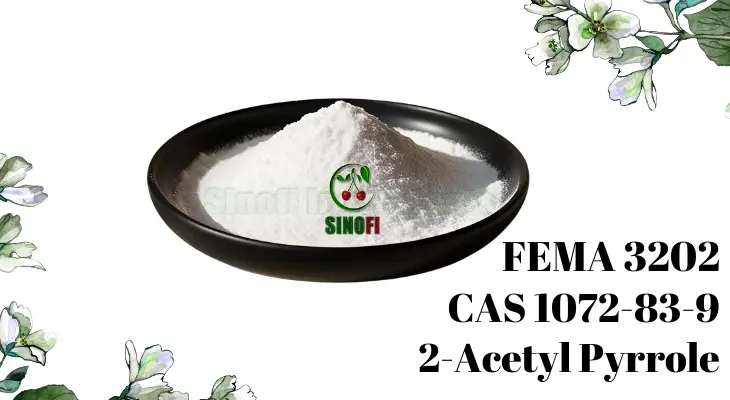
Appearance: White to light yellow crystalline powder
JECFA Number: 1307
Boiling Point: 220.00 °C. @ 760.00 mm Hg
Solubility: Soluble in alcohol, ether.
Other Names:
♦ 1-(1H-Pyrrol-2-yl)ethanone
♦ 1-(1H-Pyrrol-2-yl)ethan-1-one
♦ 2-Pyrrolylethanone
♦ 2-Pyrrolyl methyl ketone
♦ Methyl 2-pyrrolyl ketone
2-Acetylpyrrole Odor
Odor Description: At 1% in dipropylene glycol, bready, walnut, licorice-like aroma.
FEMA Number 3202
According to the Flavour and Extract Manufacturers Association (FEMA), the FEMA number of 2-acetylpyrrole is 3202.
Bulk 2-Acetylpyrrole Manufacturers
The bulk 2-acetylpyrrole production encompasses a mix of specialized flavour chemical manufacturers and diversified fine chemical producers. Top 2-acetylpyrrole manufacturers like Lluch Essence and DSM-Firmenich maintain strategically important production capacities, typically focusing on high-purity grades and specialized applications. China has emerged as the dominant manufacturing hub, accounting for approximately 60-65% of global production capacity. This concentration reflects broader trends in fine chemical manufacturing, where Chinese 2-acetylpyrrole manufacturers have leveraged cost advantages, integrated supply chains, and expanded technical capabilities to capture significant market share.
Sinofi is a bulk 2-acetylpyrrole manufacturer in China, and we have a manufacturing facility with 2,500 square meters for the production of 2-acetylpyrrole and downstream application development across e-liquid, food, flavour and fragrance, and pharmaceutical industries. We supply high-quality 2-acetylpyrrole at bulk prices and serve global clients.
Manufacturing Process of 2-Acetylpyrrole
The industrial synthesis of 2-acetylpyrrole represents a critical manufacturing process within the specialty chemicals sector, particularly for flavour and fragrance applications.
Primary Synthetic Routes
In the production process of 2-acetylpyrrole, dichloroethane, pyrrole, and acetamide are added to a reactor and stirred evenly. After a period of condensation reaction of dichloroethane, pyrrole, and acetamide, a certain amount of phosphorus oxychloride needs to be slowly and uniformly added dropwise to the reactor to carry out the condensation reaction. The materials need to be efficiently stirred, and the reaction temperature of the reactor needs to be kept stable during the reaction process. Finally, the finished product is separated and purified.
Bulk 2-Acetylpyrrole Suppliers
The global supply for bulk 2-acetylpyrrole comprises distinct tiers of manufacturers and distributors. Top 2-acetylpyrrole suppliers like Lluch Essence and DSM-Firmenich operate integrated production facilities capable of producing multi-ton quantities with consistent specifications. Some global and regional chemical distributors have established relationships with primary 2-acetylpyrrole manufacturers. They value through localized inventory management, technical support, and flexible delivery schedules.
Sinofi is a bulk 2-acetylpyrrole supplier in China, and we have a warehouse with 1,200 square meters for high-quality 2-acetyl pyrrole. We sell different grades of 2-acetylpyrrole at wholesale prices to e-liquid, food, flavour and fragrance, pharmaceutical, and agricultural chemical manufacturers.
Supply Chain of 2-Acetylpyrrole
The 2-acetylpyrrole supply chain represents a complex network of interconnected stakeholders spanning from basic chemical feedstock suppliers to sophisticated end-user industries.
Supply Chain Structure
The 2-acetylpyrrole supply chain exhibits a multi-tiered structure characterized by increasing value addition and specialization at each successive stage. At the foundation, raw material suppliers provide essential feedstocks, including pyrrole, acetic anhydride, and various catalysts required for synthesis. These primary chemical suppliers typically operate large-scale production facilities serving multiple downstream markets beyond 2-acetylpyrrole production, creating interdependencies that influence availability and pricing throughout the supply chain.
The manufacturing tier comprises specialized chemical producers who synthesize 2-acetylpyrrole through various production routes, with the Friedel-Crafts acylation of pyrrole representing the predominant industrial method. These manufacturers range from dedicated fine chemical producers focusing exclusively on heterocyclic compounds to diversified chemical companies where 2-acetylpyrrole represents one product within broader portfolios. Production facilities concentrate primarily in China and select European locations.
Distribution and logistics networks form the critical connective tissue linking manufacturers with end users across global markets. This intermediate layer encompasses international chemical distributors, regional specialty chemical suppliers, and logistics providers managing the complex requirements of hazardous material transportation.
The end-user segment demonstrates remarkable diversity, spanning pharmaceutical companies utilizing 2-acetylpyrrole as a synthetic intermediate, flavour and fragrance manufacturers incorporating it into complex formulations, and research institutions requiring high-purity grades for analytical applications.
Wholesale and Buy 2-Acetylpyrrole in Bulk
The procurement of 2-acetylpyrrole in wholesale and bulk quantities represents a critical decision point for users across pharmaceutical, fragrance, and specialty chemical sectors. As 2-acetylpyrrole buyers navigate this specialized market, the complexity of supplier relationships, pricing structures, and quality considerations demands a sophisticated approach that extends beyond traditional commodity purchasing strategies.
Volume Considerations and Pricing Strategies
Bulk purchasing economics for 2-acetylpyrrole demonstrate clear volume-based advantages that purchasing managers must carefully evaluate against inventory carrying costs and demand uncertainty. Price breaks typically occur at standard packaging increments, with significant per-kilogram cost reductions available for purchases exceeding 100Kgs. Contract structuring for bulk purchases requires careful consideration of price adjustment mechanisms, delivery schedules, and volume commitments.
Quality Specifications and Assurance Protocols
The procurement of bulk 2-acetylpyrrole demands rigorous attention to quality specifications that align with intended applications and internal processing requirements. Standard commercial grades typically specify minimum purity levels of 98 percent, though pharmaceutical and research applications often require 99 percent or higher purity with defined limits for specific impurities. Purchasing managers must ensure that specifications clearly define acceptable ranges for all critical parameters including appearance, acidity, moisture content, and residual solvents.
Supplier Relationship Management
Successful bulk purchasing strategies extend beyond transactional procurement to encompass strategic supplier relationship management that creates mutual value. Regular business reviews with key suppliers provide forums for performance evaluation, continuous improvement initiatives, and strategic alignment discussions.
As a bulk 2-acetylpyrrole manufacturer and supplier in China, we wholesale 2-acetylpyrrole to e-liquid, food, flavour and fragrance, pharmaceutical, and agricultural chemical industries. We also supply 2-acetyl pyrrole to small customers. Normally, they want to buy 2-acetylpyrrole in small quantities. To serve them, we can sell 2-acetylpyrrole at bulk prices and provide a one-stop purchasing service.
2-Acetylpyrrole Prices (USD/Kg)
Food Grade 2-Acetyl Pyrrole Prices (GC Content >=99.0%)
| Volume | Unit Price | Shipment |
| 50g | 34 USD | Express |
| 500g | 168 USD | Express |
| 1Kg | 240 USD/Kg | Express |
| 20Kg | >20% cheaper | Express |
| 100Kg-Above | negotiable | Express / Sea |
The 2-acetylpyrrole pricing reflects the intersection of specialized production economics, diverse demand patterns, and evolving market structures that characterize modern specialty chemical markets.
Current Pricing Structure and Market Levels
The contemporary pricing structure for 2-acetylpyrrole exhibits substantial variation based on purchase volume, quality specifications, and geographic markets. Industrial-grade material with standard purity specifications of 98 percent typically trades within a range that reflects both production economics and competitive dynamics among major suppliers. Premium pricing applies to high-purity grades exceeding 99 percent purity, with pharmaceutical-grade material commanding significantly higher prices due to additional processing requirements, stringent quality controls, and comprehensive documentation requirements.
Furthermore, the above price quotations of 2-acetylpyrrole do not include the express shipping fee. The reason is that the shipment cost may exceed the value of the 2-acetylpyrrole sample. However, the bulk wholesale prices will be much lower than those of small orders. Please contact us for more details.
2-Acetylpyrrole Specification
| Appearance: | White to light yellow crystalline powder |
| Odor: | Bready, walnut, licorice-like aroma |
| Purity (GC) | >=99% |
| Melting Point (°C) | 87 – 93 |
| Arsenic (mg/Kg) | <=3.0 |
| Heavy Metal (as Pb, mg/Kg) | <=10.0 |
2-Acetylpyrrole Uses
2-Acetylpyrrole exhibits a distinctive popcorn-like or nutty aroma that makes it particularly valuable in certain specialized applications.
Applications in the Flavour and Fragrance Industry
One of the most prominent applications of 2-acetylpyrrole lies within the flavour and fragrance sector. The compound serves as a crucial component in creating authentic flavour profiles, particularly those mimicking roasted, nutty, and bread-like characteristics. Food manufacturers incorporate 2-acetylpyrrole into various products to enhance or reproduce the complex flavour notes associated with baked goods, roasted coffee, cocoa products, and popcorn. The compound’s low odor threshold means that even minute quantities can significantly impact the overall sensory profile of food products.
In fragrance formulations, 2-acetylpyrrole contributes warm, toasted notes that add depth and complexity to perfume compositions. Perfumers value its ability to bridge different fragrance families, creating harmonious blends between sweet, savory, and woody elements. It finds particular use in gourmand fragrances, where food-inspired scents have become increasingly popular in contemporary perfumery.
Pharmaceutical and Medicinal Chemistry Applications
The pharmaceutical industry has recognized 2-acetylpyrrole as a valuable intermediate in drug synthesis. Its structural features make it an attractive starting material for constructing more complex heterocyclic systems found in various therapeutic agents. Research has demonstrated that derivatives of 2-acetylpyrrole exhibit diverse biological activities, including antimicrobial, anti-inflammatory, and anticancer properties. Medicinal chemists utilize 2-acetylpyrrole as a scaffold for developing novel drug candidates.
Agricultural Applications
The agricultural sector has found applications for 2-acetylpyrrole and its derivatives in crop protection strategies. Research has shown that certain derivatives possess insecticidal and fungicidal properties, making them candidates for developing environmentally conscious pesticides.
2-Acetylpyrrole in E-liquid and Vaping Products
2-Acetylpyrrole has emerged as a significant flavouring compound within the e-liquid and vaping product industry, where it contributes distinctive sensory characteristics to various formulations.
Introduction to 2-Acetylpyrrole in Vaping Applications
The incorporation of 2-acetylpyrrole into e-liquid formulations represents a specific application of this heterocyclic compound’s aromatic properties. As the vaping industry has evolved to offer increasingly sophisticated flavour profiles, manufacturers have turned to compounds like 2-acetylpyrrole to create complex and appealing sensory experiences. The compound, with its characteristic nutty, roasted, and popcorn-like aroma, serves as a key component in developing certain flavour categories that have gained popularity among adult consumers of vaping products.
The technical requirements for flavouring compounds in e-liquids differ substantially from those in traditional food applications. E-liquid flavourings must maintain stability when dissolved in propylene glycol and vegetable glycerin bases, withstand the thermal stress of vaporization, and produce consistent sensory characteristics across various device types and operating conditions. 2-Acetylpyrrole has demonstrated compatibility with these requirements, making it a viable option for e-liquid manufacturers seeking to achieve specific flavour profiles.
Flavour Profile Development and Applications
In e-liquid formulations, 2-acetylpyrrole primarily functions to impart warm, roasted, and bakery-style notes that enhance the complexity of various flavour profiles. Manufacturers frequently incorporate this compound into dessert-inspired e-liquids, where it contributes to authentic representations of baked goods, caramel, and confectionery flavours. The compound also plays a crucial role in tobacco-flavoured e-liquids, where it helps recreate the complex aromatic characteristics associated with cured tobacco leaves.
The synergistic effects of 2-acetylpyrrole with other flavouring compounds create opportunities for sophisticated flavour development. When combined with vanillin, ethyl maltol, and various lactones, 2-acetylpyrrole contributes to rich, creamy profiles that have become staples in the premium e-liquid market. Similarly, its interaction with pyrazines and other nitrogen-containing heterocycles produces complex nutty and roasted notes that add depth to coffee and chocolate-inspired formulations.
The behavior of 2-acetylpyrrole within e-liquid matrices involves complex interactions with other formulation components. When dissolved in typical e-liquid bases, the compound maintains relative stability under standard storage conditions. However, the vaporization process subjects 2-acetylpyrrole to temperatures ranging from 150 to 300 degrees Celsius, depending on device specifications and user preferences. Research indicates that under these conditions, 2-acetylpyrrole may undergo thermal decomposition or react with other e-liquid components, potentially forming secondary compounds that influence the overall sensory experience and safety profile of the product. Formulation scientists must carefully balance 2-acetylpyrrole concentrations to achieve desired sensory characteristics while maintaining product stability and consistency.
2-Acetylpyrrole Benefits
2-Acetylpyrrole represents a valuable chemical compound that delivers significant benefits across multiple industrial sectors through its unique molecular structure and versatile properties.
Flavour Enhancement and Sensory Benefits
The primary benefit of 2-acetylpyrrole in the food and beverage industry stems from its exceptional ability to deliver authentic and complex flavour profiles that would otherwise prove challenging to achieve. The compound provides manufacturers with a reliable method for incorporating warm, roasted, and nutty characteristics into their products, significantly enhancing consumer appeal and product differentiation. Unlike many synthetic flavouring agents that produce one-dimensional sensory experiences, 2-acetylpyrrole contributes depth and authenticity that closely mimics naturally occurring flavours found in roasted and baked foods.
Pharmaceutical and Therapeutic Advantages
Within pharmaceutical applications, 2-acetylpyrrole provides substantial benefits as a versatile synthetic intermediate that enables efficient construction of complex molecular architectures. The compound’s reactive sites offer multiple pathways for chemical modification, allowing medicinal chemists to rapidly generate diverse compound libraries for biological screening programs. This versatility significantly accelerates drug discovery timelines and reduces development costs compared to alternative synthetic approaches that might require more complex multi-step procedures.
Economic and Commercial Advantages
The commercial benefits of 2-acetylpyrrole extend throughout value chains in multiple industries, creating economic opportunities for raw material suppliers, manufacturers, and end-product marketers. The compound’s diverse applications enable suppliers to serve multiple market segments, reducing business risks associated with dependence on single industries or applications. This market diversification provides stability during economic cycles and supports sustainable business growth strategies.
2-Acetylpyrrole Used in Flavour and Fragrance
Organoleptic Profile and Sensory Characteristics
The sensory profile of 2-acetylpyrrole presents formulation engineers with a multifaceted aromatic compound that delivers complexity beyond simple nutty or roasted notes. The temporal release pattern of 2-acetylpyrrole differs significantly from many other pyrrole derivatives, exhibiting a rapid initial impact followed by sustained middle notes that persist throughout product consumption. This release profile proves particularly advantageous in applications where extended flavour delivery enhances product quality perception.
Temperature significantly influences the volatility and perceived intensity of 2-acetylpyrrole, requiring careful consideration during formulation development. In hot beverage applications, such as coffee and cocoa products, the compound’s increased volatility at elevated temperatures delivers immediate aromatic impact that enhances the overall consumption experience. Conversely, in frozen dessert applications, we must account for reduced volatility and adjust concentrations accordingly to achieve desired sensory targets.
Formulation Chemistry and Molecular Interactions
The formulation chemistry of 2-acetylpyrrole demands careful attention to pH conditions, as the compound exhibits varying stability across different pH ranges. In acidic environments below pH 4.0, protonation of the pyrrole nitrogen can occur, potentially altering both sensory characteristics and chemical stability. Our formulation protocols, therefore, specify maintaining pH levels between 4.5 and 7.0 whenever possible, with appropriate buffering systems to prevent drift during product shelf life.
Interactions between 2-acetylpyrrole and other flavouring compounds create opportunities for sophisticated flavour development through carefully orchestrated synergies. The compound demonstrates particularly favorable interactions with furaneol and maltol, producing enhanced sweet-roasted notes that exceed the sum of individual contributions. When combined with alkylpyrazines, specifically 2,3-dimethylpyrazine and 2-ethyl-3,5-dimethylpyrazine, we observe the formation of complex nutty profiles that closely mimic those found in roasted hazelnuts and almonds.
The presence of reactive carbonyl functionality in 2-acetylpyrrole necessitates consideration of potential Maillard-type reactions during thermal processing or extended storage. While these reactions can generate desirable flavour compounds in certain applications, uncontrolled reactions may lead to color development or off-note formation. Our formulation strategies include the strategic use of encapsulation technologies and controlled-release systems to modulate 2-acetylpyrrole availability and minimize unwanted reactions while maintaining desired sensory impact.
Application-Specific Formulation Strategies
Bakery applications represent a primary category where 2-acetylpyrrole delivers exceptional value through its ability to enhance crust and crumb flavours in both traditional and clean-label formulations. In bread and roll applications, we typically employ 2-acetylpyrrole at levels ranging from 2 to 10 parts per million in the finished product, often in combination with diacetyl and acetyl propionyl to create authentic fermentation notes. The compound’s heat stability during baking processes, where temperatures can exceed 200 degrees Celsius, ensures consistent flavour delivery without significant degradation or off-note formation.
Beverage formulations present unique challenges due to the aqueous environment and potential for interaction with other beverage components. In coffee applications, 2-acetylpyrrole serves to enhance roasted notes and mask bitter compounds, typically utilized at 0.5 to 3 parts per million in ready-to-drink formulations. For alcoholic beverages, particularly whiskey and rum flavour systems, the compound contributes aged and barrel notes when combined with vanillin, oak lactones, and phenolic compounds. Our formulation experience indicates that ethanol content above 20% enhances 2-acetylpyrrole solubility and stability, simplifying incorporation procedures.
Dairy applications leverage 2-acetylpyrrole’s ability to enhance brown butter and caramelized milk notes, particularly valuable in ice cream, yogurt, and processed cheese formulations. The compound’s interaction with milk proteins requires careful pH management and processing temperature control to prevent protein-flavour binding that could diminish sensory impact.
Stability Considerations and Shelf Life Management
The stability of 2-acetylpyrrole in finished formulations depends on multiple factors, including oxygen exposure, light conditions, temperature, and matrix composition. Formulation engineers must implement appropriate stabilization strategies to maintain 2-acetylpyrrole integrity throughout product shelf life. The inclusion of antioxidants such as mixed tocopherols, ascorbyl palmitate, or synthetic antioxidants like butylated hydroxytoluene can significantly extend stability, though selection must consider regulatory restrictions and label requirements.
A Method for Black Truffle Flavoured Microcapsule Essence Using 2-Acetylpyrrole
Include the following steps:
(1) Mixing an aroma component and an auxiliary component in a mass ratio of 2:98, homogenizing them three times at room temperature at a pressure of 20 MPa to obtain a core component emulsion;
(2) Mixing the wall component and deionized water in a mass ratio of core component: wall component: deionized water of 10:20:70, and fully dispersing them at 50°C to obtain a wall material emulsion;
(3) Adding the core component emulsion prepared in step (1) to the wall material emulsion prepared in step (2), and shearing them at high speed for 5 minutes, then transferring them to a homogenizer at a pressure of 40 MPa for homogenization for 20 minutes, filtering, and obtaining a black truffle flavoured microcapsule essence treatment liquid;
(4) Treating the black truffle flavoured microcapsule essence treatment liquid with a spray dryer, wherein the feed rate of the spray dryer is 1 L/min. The air inlet temperature is 180°C, and the air outlet temperature is 80°C. This produces black truffle flavoured microencapsulated essence.
The aroma component includes the following ingredients by weight: 0.1 part acetic acid, 0.2 part octanoic acid, 0.1 part butyl dodecalactone, 0.1 part 3-octanol, 0.1 part 1-octen-3-one, 1 part 1-octen-3-ol, 0.2 part bis(2-methyl-3-furyl) disulfide, 0.4 part 5-methylfurfural, 0.02 part 2,4-decadienal, 1 part ethyl maltol, 0.05 part furanone, 0.01 part isovaleraldehyde, 0.3 part furfuryl alcohol, 0.2 part phenylethyl alcohol, 1 part benzyl alcohol, 0.02 part 2,3,5-trimethylpyrazine, 0.2 part 2-acetylpyrrole, and 0.2 part 2-acetylthiazole.
Auxiliary components include natural antioxidants and salad oil. The natural antioxidant is a mixture of β-carotene and tea polyphenols in a 7:1 weight ratio, with the total amount used accounting for 0.02% of the total weight of the auxiliary components.
The wall material component is a mixture of sodium starch octenylsuccinate, gum arabic, and soy protein in a 4:1:1 weight ratio.
In conclusion, 2-acetylpyrrole stands as a remarkably versatile compound with established applications spanning the flavour and fragrance industry, pharmaceutical development, agricultural science, and material technology. As a bulk 2-acetylpyrrole manufacturer and supplier in China, we sell different grades of 2-acetylpyrrole at wholesale prices to large manufacturers and small customers in the world.